
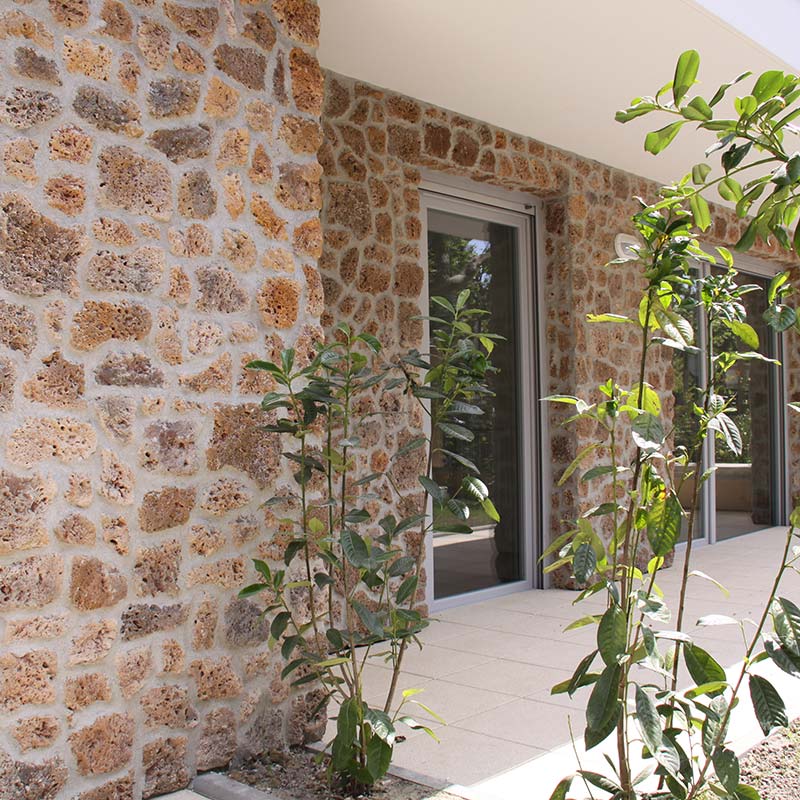
A millstone house can be maintained, but not with just any product or method. It all depends on the actual condition of the façade.
Millstone is one of the most characteristic façades in the architectural heritage of the Paris region. Composed of flint and iron oxides, it produces ochre and brown hues and ages well, provided it is maintained with care. Every mistake leaves a lasting mark on a material that doesn’t forgive approximation. Before getting out the brush or ordering a cleaner, the decisive step is to read the condition of your facade. It dictates the method.

Millstone, a porous material that requires careful reading before cleaning
Cleaning millstone always starts with an inspection, rather than with a bucket of water or any cleaning product. What works on one dense limestone can weaken another in just a few applications.
Stone’s high porosity makes it vulnerable to two distinct phenomena. On the one hand, moisture absorption encourages the development of mosses, lichens and micro-organisms that embed themselves deep down.
On the other hand, freeze/thaw cycles weaken the internal structure of the cladding if it becomes waterlogged. A high-pressure cleaner, often used as a first line of defence, exacerbates precisely these two problems: it opens pores, degrades joints and accelerates moisture penetration.
Clean millstone according to degree of soiling
Cleaning millstone always begins with the least invasive action possible. The aim is to restore the stone’s original appearance without weakening its structure or damaging the joints.
Façade blackened or invaded by moss: defoamer, pH-neutral cleaner and water repellent in the right order
When moss, lichen or black deposits are deeply entrenched, gentle cleaning is no longer enough. The order of treatment is decisive here. The first step is to apply an anti-moss or biocide product suitable for natural stone, and leave it to work for 24 to 48 hours, according to the manufacturer’s recommendations. Vegetation will dry out and loosen naturally. Then clean with a brush and pH-neutral cleaner to remove residues.
Once the surface is clean and dry, application of a microporous water repellent protects it from future infiltration, while allowing it to breathe. Without this last step, moss will reappear within a few seasons. For facades that are heavily soiled or blackened by decades of urban pollution, professional hydro-scrubbing remains the most effective and least aggressive solution for restoring millstone to its original lustre.
Slightly soiled front panel
For facades with only dust deposits or light surface pollution, cleaning with clear water and a soft brush is sufficient in most cases.
Moisten the surface, scrub with a pH-neutral cleaner diluted in warm water, black soap, soda crystals or a special masonry cleaner, then rinse thoroughly from top to bottom, as for exterior stone cladding.
White vinegar and bleach should be avoided: the former attacks the iron oxides that give millstone its characteristic hue, while the latter weakens the joints and unbalances the porosity of the stone. A test on a small area is recommended before general application.

Damaged joints or deteriorated stone: the point at which maintenance becomes renovation
Crumbling joints and flaking stone cannot be treated with a cleaner. At this stage, continuing surface maintenance without treating the structure is tantamount to masking deterioration that will worsen, particularly under the effect of winter freeze/thaw cycles.
Signs that a professional is needed
Several signs indicate that routine maintenance has been exceeded. Joints that have been reduced to powder or are completely absent in certain areas, stones that feel hollow to the touch, recurring traces of dampness inside the walls, or a facade whose blackening resists several attempts at cleaning.
In such cases, calling in a specialist millstone façade builder avoids aggravating the damage with inappropriate interventions.
Lime pointing: why the original material counts
Joints on a millstone facade are traditionally made with air lime: the material remains flexible, permeable to water vapor and lets the facade breathe.
Replacing it with cement mortar, which is more rigid and impermeable, creates tension and encourages lateral infiltration. When repointing, choosing an air lime mortar that complies with heritage practices is the guarantee of a lasting renovation that respects the original properties of the facing. For homeowners planning a more in-depth renovation, the question of the choice between natural stone and reconstituted stone is worth asking.