

Neat steps, rough cheeks and bare risers. A poorly dressed exterior staircase betrays even the most beautiful garden. Dressing every surface transforms a simple passageway into an element of landscape architecture.
An external staircase structures the circulation in a garden, linking a terrace to the lawn and marking a difference in level or access punctuation. Often, the cladding concentrates on the treads, leaving out two equally visible surfaces: the risers and the sides. These are what determine whether the cladding really blends into the garden or stands alone. Choosing a coherent outdoor covering means thinking of the three surfaces together, in relation to the style of the garden, the materials already present and climatic constraints.
Why are outdoor staircases designed in three surfaces?
In the majority of exterior landscaping projects, only the steps are given a careful covering. The risers and sides are left in raw concrete or exposed breeze-block, either through lack of foresight or ignorance of the solutions available. It’s precisely this imbalance that gives so many garden staircases an unfinished look. The three surfaces need to be treated in a coherent manner to become a visual landmark in the garden, in the same way as a low wall clad in stone or a terrace clad in flagstones.
In a contemporary garden, exterior stair cladding plays the mineral card
A contemporary garden is all about straight lines, geometric volumes and few different materials. For the outside staircase, the ideal cladding is reconstituted stone in shades of grey, anthracite or cool beige, laid identically on the treads, risers and cheeks.
Reconstituted stone and concrete lend coherence to clean lines
Concrete-effect or smooth stone-effect finishes blend effortlessly into a garden where plant life is contained and structured. Reconstituted stone offers a concrete advantage over natural stone: its dimensions are regular, its shades homogeneous, and its installation on vertical surfaces such as cheeks or risers poses no technical difficulties.
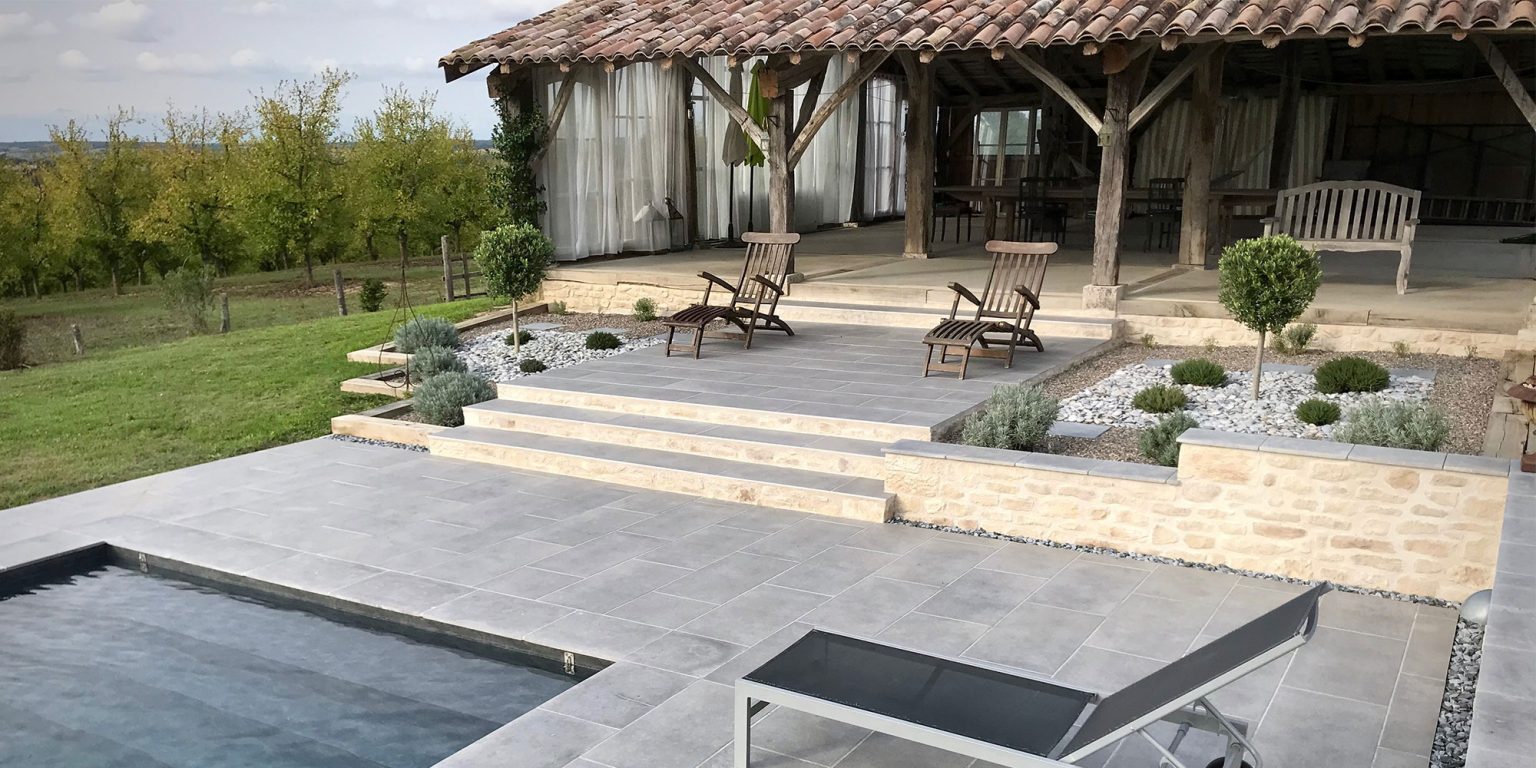
Staircase, terrace and wall in the same material unify the entire space
This is the fundamental rule of successful outdoor design. When step cladding, cheek cladding and adjacent wall cladding share the same material, the garden gains in coherence and visual depth. In a contemporary garden, this unity of material also simplifies long-term maintenance, and applies equally to thedesign of an outdoor terrace.
In a natural garden, external stair cladding disappears into the vegetation
A natural garden is a space where plants dominate and minerals fade into the background. Plants overflow onto the paths, materials are raw and colors muted. For the exterior, the ideal cladding is reconstituted stone in shades of beige, ochre or taupe, with an irregular texture reminiscent of country stone. The aim is for the staircase to blend into, rather than stand out from, its surroundings.
Muted hues and irregular textures integrate effortlessly
In a natural garden, a stone with too smooth a sheen or too uniform a hue creates a contrast that betrays the overall effect. A dry-stone or rubble-effect finish, in earthy tones, blends naturally between flower beds and lawns. Applied to the sides and risers, it gives the staircase the appearance of something that has always been there. To find out more about the use of stone in a natural garden, take a look at our stone landscaping ideas for inspiration.
Treating the cheeks like the adjacent low wall blurs the boundary between mineral and vegetation
A garden staircase often adjoins a retaining wall or masonry border. When the sides are clad in the same material as the retaining wall, the separation between the two elements disappears. The choice of cladding for a low garden wall follows the same criteria.