

A stone house facade can incorporate white stucco, wood siding, or both in a single design. This choice applies to both new homes and renovations, whenever the goal is to add depth, light, or visual warmth to the facade. Success hinges on three key decisions: assigning a specific role to each material, distributing the surfaces according to the building’s volumes, and choosing tones that complement the stone.
How can you create a beautiful facade using white stucco and wood siding?
Light highlights the large surfaces, and the wood adds warmth to the spaces with its grain and natural tones. The balance comes from the distinct character of each material and the way they are combined on the facade.
In a new home, this combination helps break up the monotony of a space that is too uniform. In a renovation project, it also helps modernize the facade of a stone house without losing its character.
Assign a specific role to each material
Stone should be the most expressive element of the facade. It draws the eye with its reliefs, joints, textured surfaces, and mineral tones. When used throughout the house, it creates a strong exterior shell. When placed in a specific area, it highlights a threshold, a corner, a gable, or a terrace.
White plaster acts as a breathable surface. It softens the stone’s texture and reflects more light, especially on facades that receive little sunlight or are surrounded by vegetation. An off-white, cream, or light sand color often creates a softer look than pure white, particularly when paired with beige, golden, or ochre-colored stone.
Wood siding adds a warmer, more linear touch. It works well on a secondary structure, for example, because its boards guide the eye. When installed vertically, it makes the facade appear more slender. When installed horizontally, it elongates the structure and accentuates the sense of length.
Creating a Harmonious House Facade Using Three Materials
A harmonious house facade often relies on a limited color palette. Three materials are enough as long as the tones are kept in check. A slate-look cladding in a nuanced beige tone, such as Strata, pairs well with off-white stucco and light-colored wood.
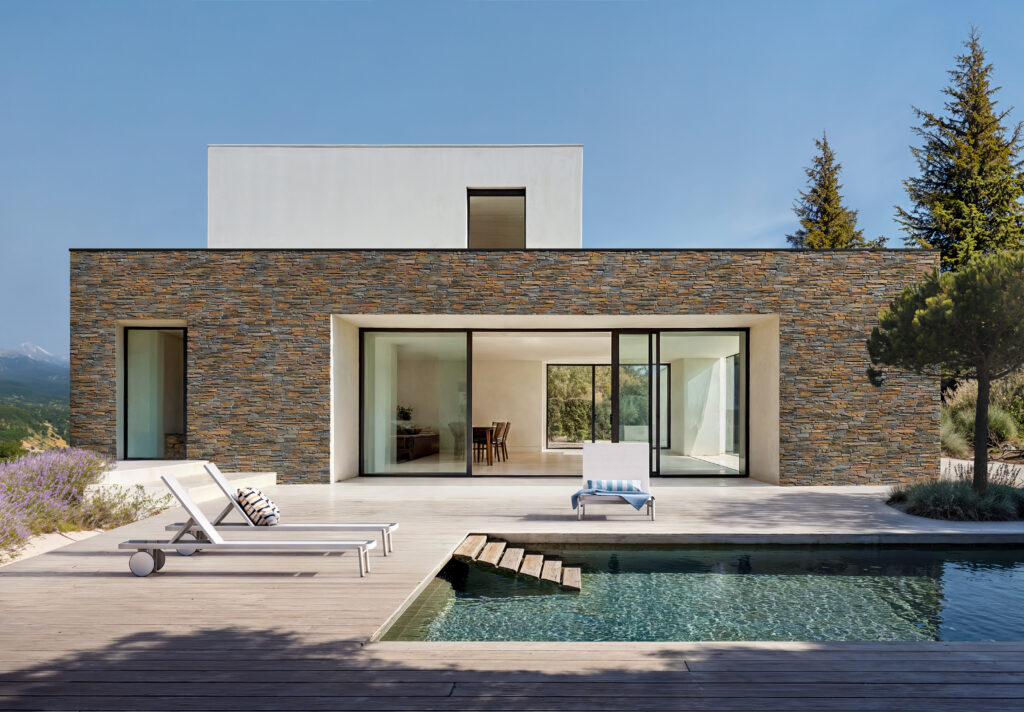
Gray stone pairs well with a light-colored stucco and darker wood. Stone with golden hues, such as Meulière, works better with cream-colored stucco than with cool white.

The window and door frames complete the design. Anthracite-colored windows accentuate a contemporary facade featuring stone, wood, and white. Sand-colored or light brown frames complement a home with natural tones more effectively. The facade achieves greater harmony when the materials, openings, and finishes seem to follow the same architectural style.
Where should the stone be placed on a house’s facade?
Facing stone should be placed where it enhances the building’s visual impact. On a house’s facade, it can anchor the structure to the ground, mark an entrance, frame a patio, or create a visual connection with the outdoor landscaping. Its placement is just as important as its color.
At the base, to anchor the facade
A stone base provides a visual foundation for the house. It connects the structure to the ground, especially when the facade borders a driveway, a sloping garden, or a stone terrace. This design also works well on stuccoed houses, where the stone accentuates the base without overwhelming the upper floors.
The base also gives a more robust appearance to areas close to the ground. It runs along thresholds, garage entrances, and the edges of patios—areas that are often more exposed to foot traffic and splashes. With white stucco above, the contrast remains sharp, and the facade gains depth starting from the first level.
On a section of wall to mark the entrance or the patio
A section of stone wall naturally draws the eye to a specific area. Placed around the entrance, it adds character to the doorway and frames the transition between the outdoors and indoors. On a terrace, it creates a natural backdrop that feels warmer than a uniformly plastered wall.
This solution works well for the facades of contemporary homes, as it allows the stone to be treated as a structural element rather than merely as an added decorative feature. The cladding can be applied to an entryway wall, the side of a bay window, or a gable, while the white stucco keeps the other surfaces more understated. Wood siding can then be used as a complementary element, for example on a canopy, an upper story, or an addition.
Reminder regarding low walls, pillars, and fences
Stone takes on greater presence when it is used on exterior elements. A low wall, gateposts, or a fence can feature the same cladding as the main facade. This continuity connects the house to its garden and creates a sense of continuity visible from the property’s entrance.
This approach works particularly well when the facade combines several materials. Stone can be used sparingly on the main structure, then reappear on a pillar, a low wall, or an exterior frame. The overall effect appears more refined, without overcomplicating the facade itself.
Which ORSOL collections should you choose for this type of facade?
Cladding for a traditional house facade
Collections such as Causse and Manoir reflect this desire for materials with deeper roots. These shades complement off-white, cream, or light sand-colored plaster. They also complement light-colored wood, brown trim, and tile roofs.
“Causse” evokes light-colored limestone. “Manoir” offers a more traditional aesthetic, well-suited to historic homes, renovations, and facades that seek to connect with regional architectural styles.
More pronounced contours for contemporary architecture
A contemporary facade can feature a more graphic cladding, especially when the stone is placed on a specific section of the building. The texture adds depth to an entry wall, a gable, or a terrace extension. The white stucco keeps the main surfaces more understated, while the wood adds warmth to the overall design.
Shades of gray, granite, or anthracite reinforce this effect. They work well with dark window and door frames, brown wood siding, or facades with more horizontal lines. The cladding then creates a sharp contrast without introducing too many different materials or tones.

What precautions should be taken before installing exterior siding?
Installing a facade cladding requires an assessment of the substrate, the bonding method, and the finishes exposed to the elements. The final appearance depends as much on the choice of stone as on the preparation of the wall, the treatment of the corners, and the protective coating applied after installation. Clean edges, well-chosen joints, and even installation give the facade a cleaner, more defined look.
Check the installation method
ORSOL has developed the IDÉAPOSE process for installing its filled and unfilled cladding systems on approved substrates. This step helps define the installation process, the adhesive products, and the technical limitations of the project. On an exterior facade, it primarily prevents careless work that could compromise the durability of the finished product over time.
Pay close attention to joints, corners, and connections
Grout directly affects the appearance of the stone. Beige grout softens a facade with natural tones. Gray grout further emphasizes the lines. White grout can create a contrast with light-colored plaster, provided it matches the tone of the facing.
Corners require the same attention. A facade featuring stone, white stucco, and wood siding often incorporates changes in plane: an entryway recess, a gable, a base, and a terrace surround. Well-executed corners prevent a “veneer” effect and lend greater depth to the mineral material. The joints must remain clean, as they define the visible lines of the facade.
Preserving a Stone House Facade for the Long Term
A stone house facade exposed to rain, frost, sunlight, and splashes requires appropriate protection. For exterior use, ORSOL recommends applying a water-repellent treatment to the affected surfaces. This treatment helps minimize the impact of external elements and helps preserve the material’s appearance.
The durability of a facade is therefore determined right from the design stage. The choice of cladding, the preparation of the substrate, the quality of the joints, and the final protective coating all form a single, integrated whole. When these factors are taken into account from the outset, the stone retains its texture and continues to complement the white stucco or wood siding throughout the seasons.
The combinations of stone, white stucco, and wood siding evolve with architectural trends, but the underlying principle remains the same: to assign a specific function to each material. Stone adds texture, stucco brightens the spaces, and wood introduces a warmer feel. When these three materials interact in harmony, the facade retains its character while aging more naturally over the years.