
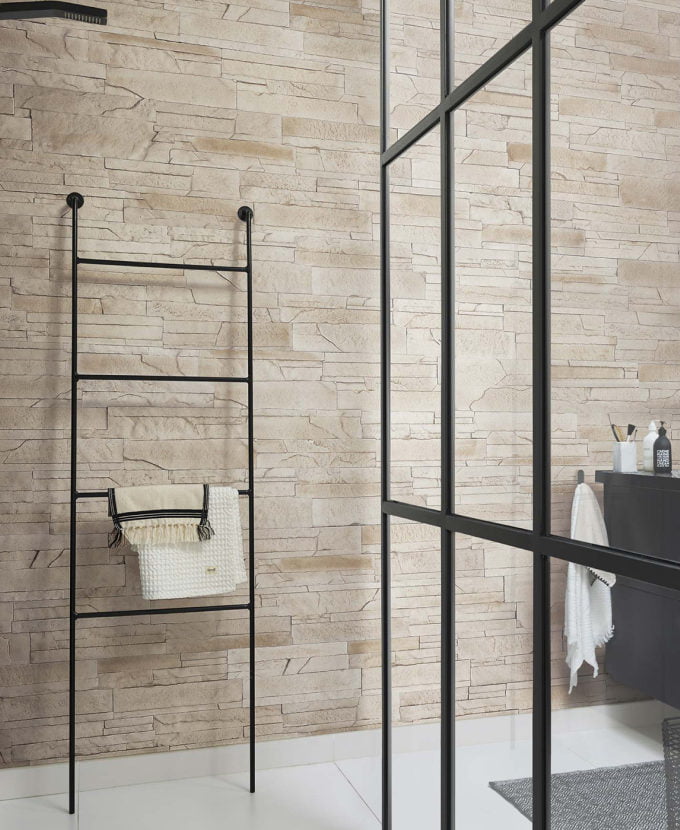
In a bathroom, stone adds depth, texture, and a mineral-like quality to the decor. But when it comes to natural versus reconstituted stone, the differences go beyond just appearance. So, which stone cladding should you choose? Moisture resistance, maintenance, weight, and budget: each material has its own characteristics. Here are the criteria to consider when choosing a cladding that’s right for your room and its intended use.
Natural and Reconstructed Stone: What Are the Differences?
Before choosing a flooring material, it’s important to understand how these two materials are manufactured and how they differ. Their composition directly influences their appearance, properties, and recommended uses.
Natural stone: an authentic material with variable properties
Natural stone is quarried directly from rock, then cut and shaped to create the desired flooring. Whether it’s marble, travertine, slate, granite, or limestone, each variety has its own unique characteristics.
Its main appeal lies in its appearance. The grain, color variations, and irregularities are unique to each piece. They give it an authentic look that is difficult to replicate exactly.
However, not all natural stones have the same resistance to moisture. Some, such as travertine and limestone, are more porous. They can absorb water and become stained without proper protection. Marble also requires special precautions when it comes to acidic products.
Reconstituted stone: an easier-to-maintain alternative
Engineered stone is made from mineral aggregates combined with a binder, then molded to replicate the appearance of various types of rock. Its composition varies depending on the manufacturer and the manufacturing process.
It allows for the recreation of natural textures, reliefs, and nuances, while providing greater control over the dimensions and appearance of the elements.
At ORSOL, NÉOMINÉRAL technology is based on a composition that is 99% mineral-based. The resulting cladding panels are thin and lightweight, making them easy to handle and install.
Reconstituted stone is therefore an attractive solution for wall cladding without the weight and installation challenges associated with certain natural stones.
Which stone should you choose to withstand the humidity of a bathroom?
Moisture is a key factor. A bathroom exposes floor and wall coverings to water vapor, condensation, and splashes. However, not all surfaces are subject to the same stresses.
Different levels of resistance depending on the installation area
On a wall far from the shower and sink, materials are primarily exposed to ambient humidity. Both natural stone and engineered stone may be suitable, provided the manufacturer’s recommendations are followed.
Around a vanity or bathtub, water splashes occur more frequently. A suitable water-repellent coating limits water penetration and reduces the risk of stains.
In a shower, the demands are even greater. The coating must be specifically designed for direct and repeated exposure to water. An appropriate waterproofing system must also be installed at the substrate level. A simple water-repellent surface treatment is not a substitute for this protection.
The choice should therefore not be based solely on the type of stone: the product’s technical data sheet and its intended use remain essential.
Should a water-repellent treatment be applied?
Porous natural stone generally requires a water-repellent treatment to limit its water absorption. How often this treatment needs to be reapplied depends on the type of stone, its finish, and its exposure to moisture.
Reconstituted stone is not automatically waterproof. Its performance depends on its composition and technical characteristics.
For NÉOMINÉRAL cladding, ORSOL recommends applying a water-repellent treatment after installation in damp rooms. According to the manufacturer’s recommendations, this protection should be reapplied approximately every five years.
Maintenance and Cost: Which Material Offers the Best Value?
Beyond installation, the choice of flooring must take into account its long-term maintenance and the overall cost of the project.
What kind of maintenance does each material require?
Natural stone requires special care depending on its composition. Marble and travertine, for example, are sensitive to acidic products that can damage their surface. White vinegar and conventional limescale removers should therefore be avoided on these materials.
For routine cleaning, use water and a pH-neutral cleaner. Regular wiping also helps minimize lime scale buildup and water marks.
Reconstituted stone generally requires fewer precautions, but it must also be maintained using products that are compatible with its finish. For ORSOL cladding, gentle, pH-neutral cleaning helps preserve its appearance.
Maintenance tipsfor stone cladding help you understand the precautions to take based on how it is used.
How much should you budget for a stone bathroom?
Natural stone generally comes with a higher purchase price. The cost depends on the type of stone chosen, its origin, its rarity, its size, and its finish. Cutting and installation costs can also add to the overall budget.
Reconstituted stone is often more affordable. Because it is manufactured using a molding process, it can be produced in uniform sizes, and its lighter weight makes it easier to handle and reduces certain installation challenges.
However, to properly compare the two options, you must take into account the total cost: the purchase price of the flooring, surface preparation, adhesive, grout, protective treatment, and labor. A material that is cheaper to buy is not necessarily the most cost-effective once it is installed.
Ultimately, the choice depends above all on your priorities. Natural stone appeals for its unique variations and authentic character, while engineered stone offers greater uniformity and is often easier to install. In both cases, moisture resistance and installation conditions should guide your decision.