Skip to content

How to select the ideal wall for your garden?

Inspiration 18 Dec 2025
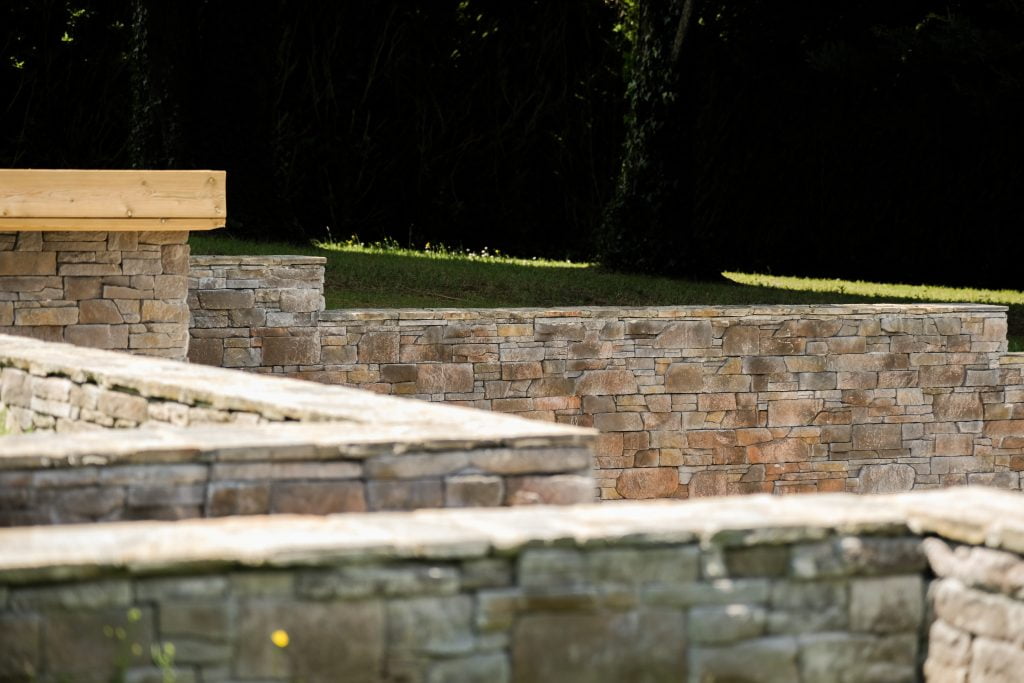
Muret de jardin en parement Rocky Mountain ton naturel avec cloture en bois

A discreet element or a landscape signature, the low wall shapes the way a garden looks. It creates levels, protects a terrace, frames an entrance or accompanies a flower bed. Its material, height and line define the ambience of the garden, from the most mineral to the most contemporary.

Determining the use of your low wall

The wall’s primary function influences its height, thickness and choice of material.

Underpinning and level creation

A retaining wall stabilizes sloping ground and requires a solid structure with drainage. Its relief must remain legible from a distance to clearly mark the different levels of the garden.

Soft boundary or visual separation

To frame a terrace or structure a pathway, a low wall (40 to 70 cm) creates an elegant boundary without partitioning. Its moderate height preserves views while providing a coherent visual landmark in the landscape.

Integrated seating or landscape furniture

At seat height, the low wall becomes a convivial element. It can be used for planting, as a bench or to emphasize a rest area, while reinforcing the overall harmony of the garden.

Choose siding to match the style of your garden and home

The cladding simplifies the dialogue with existing materials and the style of works implemented on the property. A few guidelines will help you create a coherent whole.

Contemporary style: sober lines and mineral tones

To create a modern exterior wall, uniform geometrically assembled surfaces have a strong visual impact. Infinity cladding, inspired by mass-produced concrete, structures the space with a subtle relief. Concrete grey or anthracite shades reinforce the graphic character.

The Portland collection, with its soft, even relief, also offers a refined aesthetic that is perfectly suited to today’s architecture.

Portland natural tone

Natural or Mediterranean setting: dry-stone variations

In a garden planted with local species, stone creates a sensitive continuity between mineral and plant. The natural, golden-beige or clay-earth shades of the Causse, Tertus or Olympe collections provide a warm relief, perfect for a decorative exterior wall that blends into the landscape.

The various ORSOL collections in Neomineral stone faithfully reproduce the texture of natural stone while benefiting from a low-carbon, sustainable material.

House entrance in natural-tone Causse cladding
Causse natural tone

Traditional style or inspired by regional architecture

For a warm rendering, shaded brick or stone textures evoke ancient materials and create a direct link with the local built landscape. They provide an authentic expression that underlines the history of the site.

The Brick collection or Old School Brick, rich in relief, enhances plantings and paths.

For a more contemporary version, Chromatik brick features a smooth surface and protected tones thanks to the factory-installed water repellent.

Ideas for low walls to transform the garden

A low wall is a genuine landscape composition tool. Here are a few tips to help you create a design that’s right for every exterior.

Low wall around the terrace

A low wall in light colors (Olympe naturel, Causse beige doré) diffuses soft light around a dining area. Mineral textures catch the sun and create a warm atmosphere.

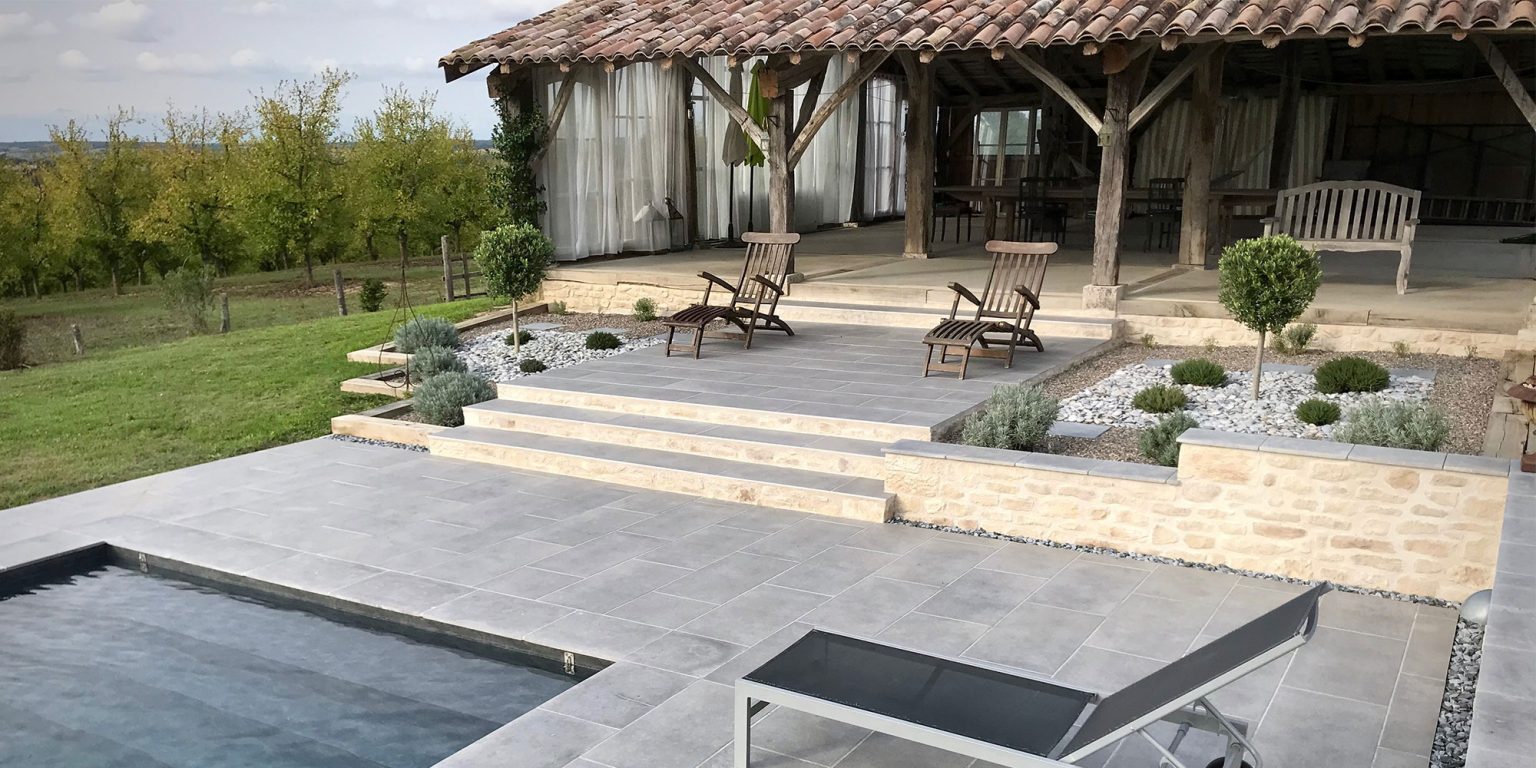
In-ground pool with low wall in OLYMPE clay-tone cladding
Olympe ton Terre d’argile

Pool wall with a strong mineral presence

Around a pool, stone in Anthracite (Yosemite or Rocky Mountain) creates a powerful contrast with the water. Relief marks the space and visually anchors the pool deck.

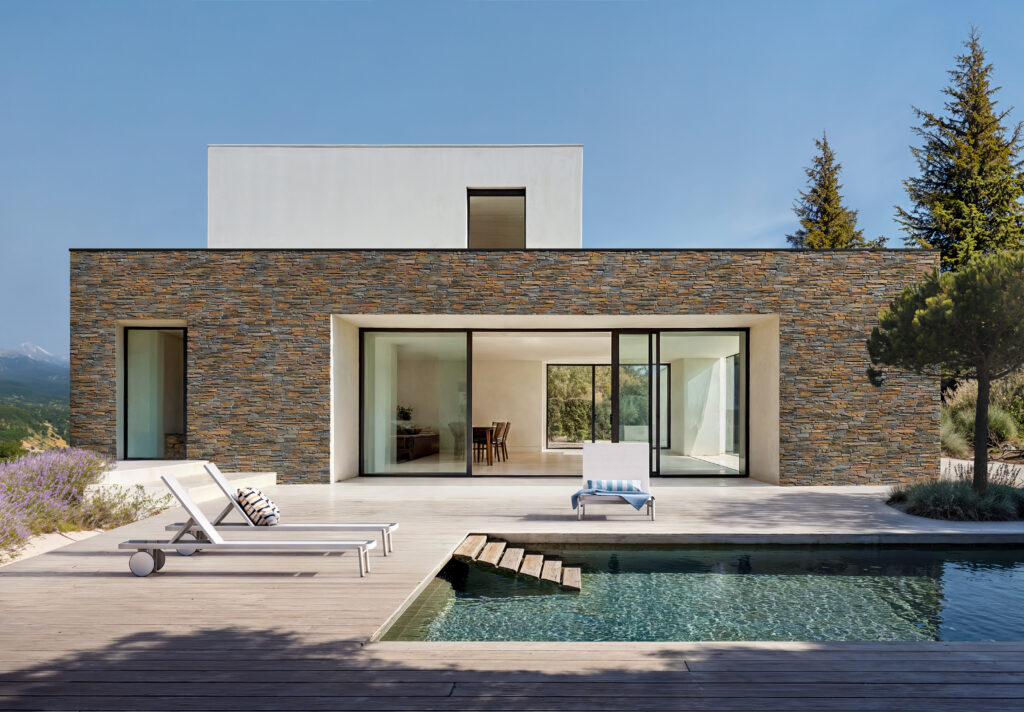
New home with in-ground pool and Rocky Mountain cladding in natural tone
Rocky Mountain natural tone

Dry stone retaining wall

The Roca collection, pre-assembled on trellis for fast, intuitive installation, is ideal for long wall lengths. Its play of thicknesses enhances the natural character of sloping gardens.

Decorative wall with integrated seat

By choosing a softly shaded cladding (Tertus, Causse pierre), the low wall can easily be used as a support for outdoor decorative elements: pots, lanterns or cascading plants. The mineral grain accentuates the warmth of the sunset.

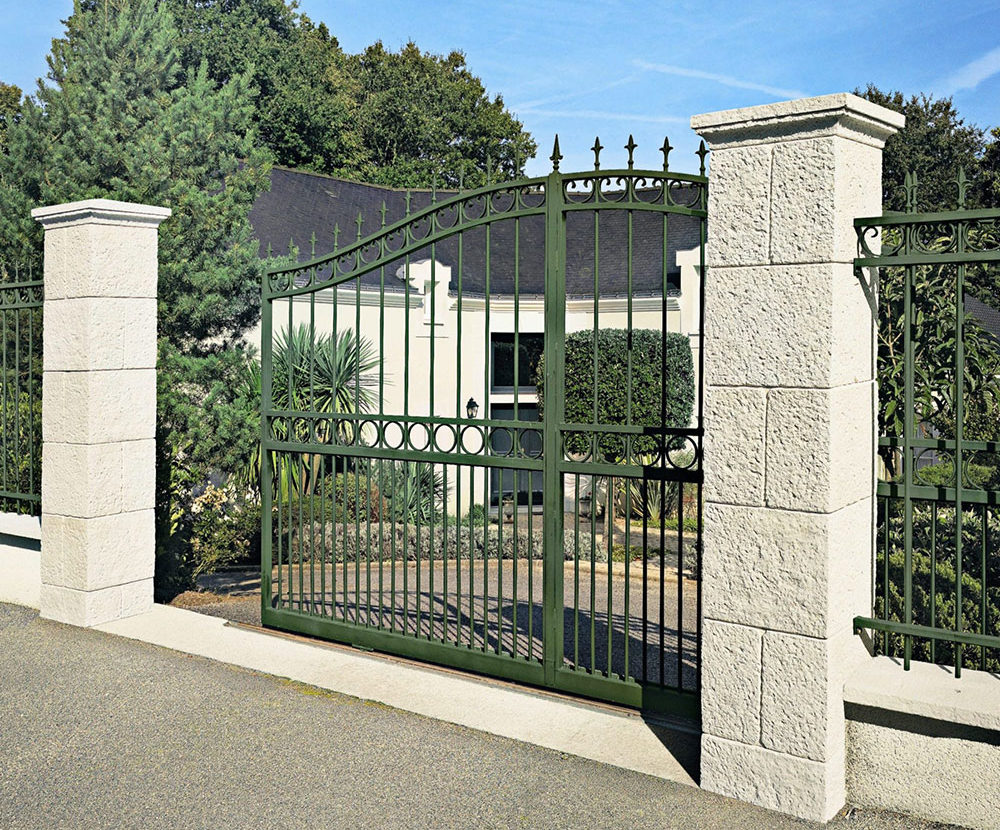
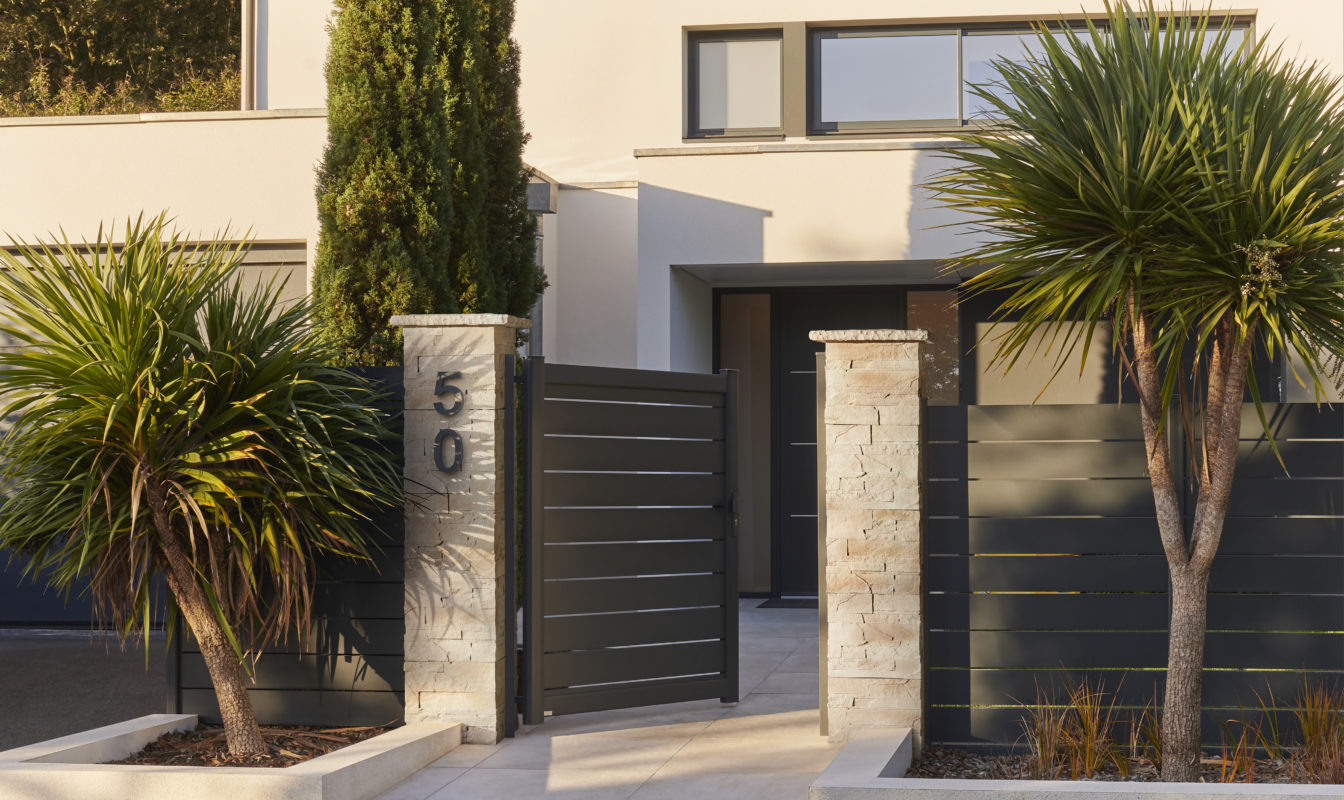
Low entrance wall with pillars

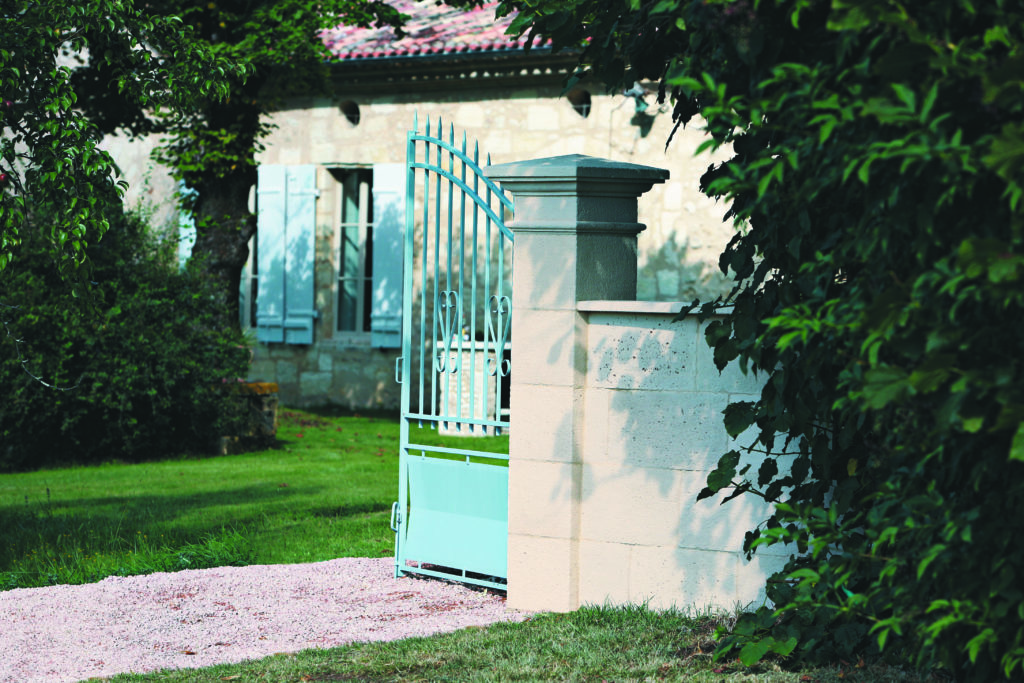
To mark the entrance to the property, the low wall can be extended with matching pillars. The Bridoire, Valancay or Portland collections offer several formats and reliefs, creating a complete, harmonized ensemble. Wall caps provide long-lasting protection against run-off.

With ORSOL’s Neomineral stone collections, each cladding offers a unique way of sculpting relief and bringing a mineral emotion to the exterior. And to support even the most demanding projects, ORSOL’s network of installers ensures precise rendering, faithful to the desired effect.

Portal wall with Rocky Mountain natural tone cladding
Rocky Mountain natural tone

The advantages of a stone façade

Inspiration 09 Oct 2025
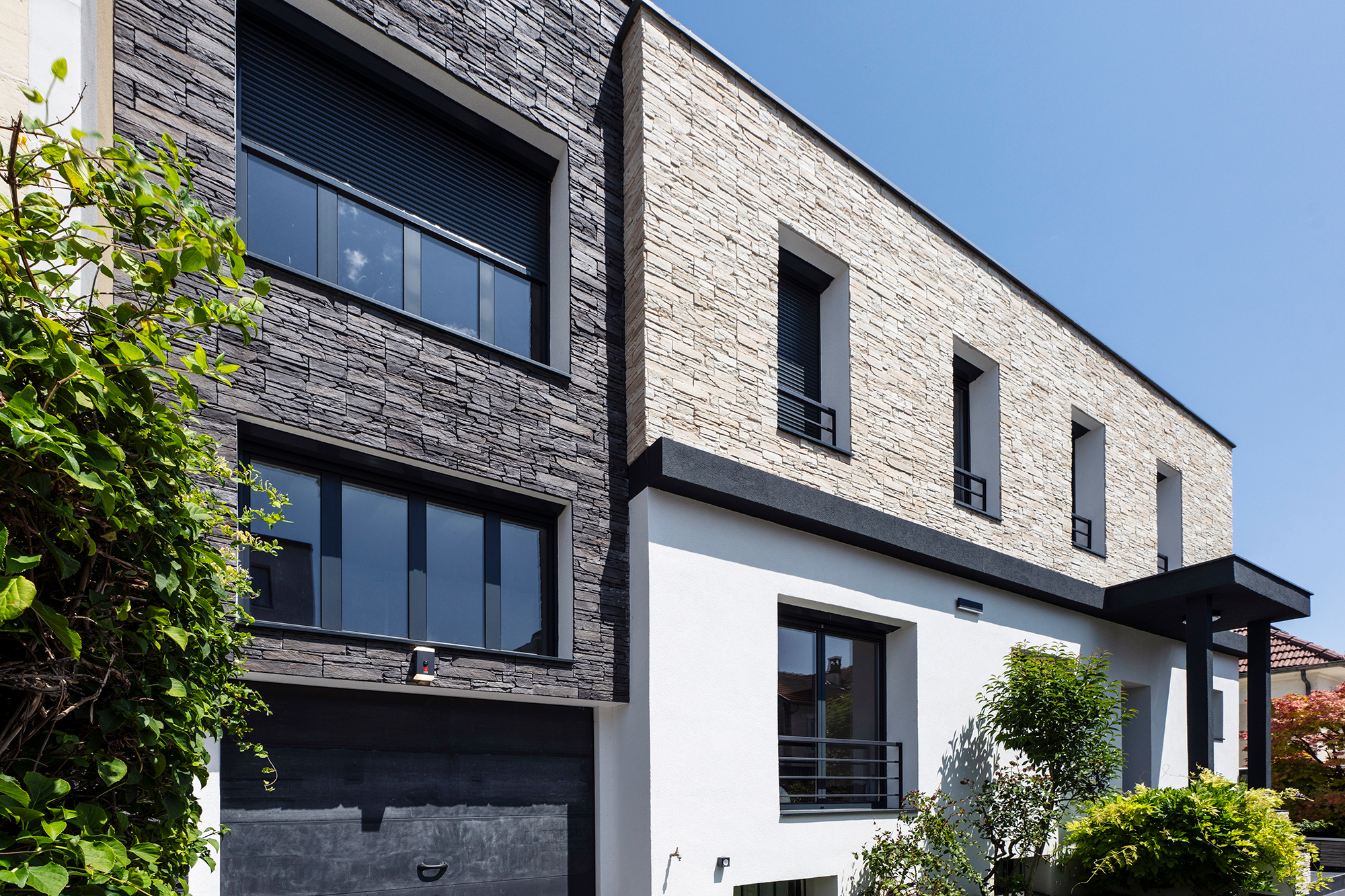
Bâtiment moderne habillé de revêtement Rocky Mountain ton gris nuancé sur une façade

Stone facades seduce not only by their authenticity, but also by their performance. Recyclable, frost- and fire-resistant, it meets today’s demands for durability. Its variations, from solid stone to mineral facings, multiply the architectural possibilities.

Stone, a vector of authenticity in residential facades

In residential projects, stone expresses an authenticity linked to construction know-how and built landscapes. When used on facades, it brings a house closer to its architectural environment, using textures, tones and mineral effects that echo local traditions. This anchoring does not prevent it from being integrated into contemporary creations, where it becomes the support for sober, sustainable architectural expression.

4 advantages of a stone façade in the home

A stone façade stands out as much for its visual impact as for its technical performance. It provides lasting protection for the building envelope, enhances interior comfort and meets safety requirements.

Proven weather resistance

Stone’s density and porosity vary according to its origin, but it remains one of the most resistant materials to freeze-thaw cycles and infiltration. Its durability is demonstrated by the preservation of relief and nuance, even after decades or even centuries of exposure.

Proven thermal comfort, especially in summer

Thanks to its high inertia, stone stores heat and releases it slowly inside the home. In summer, this natural regulation reduces overheating of rooms in the middle of the day, when outside temperatures peak.

Sunny terrace in the perched Corsican village of Pigna

Fire safety

Stone is non-combustible and helps protect facades. As such, it is one of the most reliable answers to current fire safety standards in residential construction.

Reuse and respect for the environment

Natural stone is recyclable and can be reused in construction. When quarried locally, it limits the carbon impact of transport.

Low-carbon alternatives such as the ” Neomineral ” material developed by Orsol now make it possible to achieve the same visual effect with even less environmental impact.

What are your options for an exposed stone façade?

The look and performance of a natural stone façade depend on the precise nature of the material and its application. Whether solid, cut, in rubble or clad with a thin facing, stone can deliver very different architectural renderings and respond to singular technical constraints.

Solid stone and ashlar: nobility and monumentality

Carved in thick blocks, these stones support the structure or provide lasting cladding for the façade. Finely jointed ashlar is still associated with the finest heritage buildings, and ensures remarkable resistance to the elements.

Terrace with Tahoe stone facade in a rocky tone

Rendered rubble stone or traditional stonework

Common in rural architecture, rubble stone is rarely left exposed. They require a protective coating, usually lime-based, to protect the masonry from damp and frost.

Thin cladding / exterior stone cladding

Thin, stone-like claddings are mechanically fastened or glued to a substrate. Regulated by the NF DTU 55.2 standard, these systems can create a ventilated facade that improves performance while reducing wall thickness.

Neomineral cladding: the contemporary alternative

A low-carbon material developed by Orsol, Néominéral restores the visual appearance of natural stone while simplifying installation. This cladding makes it possible to create accessible mineral facades, with environmental performance verifiable by the FDES (Fiches de Déclaration Environnementale et Sanitaire).

How to create an accent wall with wall cladding?

Inspiration 18 Sep 2025
Cuisine lumineuse avec un mur en parement Brique 5 tons

Do you dream of an interior with character, without the need for extensive renovation? Creating an accent wall is a simple and accessible action that immediately transforms the atmosphere of a room. The possibilities for personalization and the supports are multiple: paint, wallpaper, wood… And what if the solution lay in stone? Between mineral textures and natural shades, Orsol wall claddings offer an elegant, technical and timeless answer to all your wall design desires.

The accent wall: function and decorative interest

Often used in interior design to punctuate a space or create a visual break, the accent wall is a real design lever.

Renovate an interior wall differently

Unlike neutral walls that serve as a backdrop, it deliberately draws attention through its color, texture or material. It thus becomes a visual anchor, a landmark in the room.

This process can be used to define a function (dining area, reading area, headboard) or simply to liven up a decor that’s too uniform.

Where to place the accent wall?

The success of an accent wall depends largely on its location. It’s best to place it on a wall that’s visible as soon as you enter the room, or behind a strong feature such as a sofa, bed or table.

It needs to stand out, without unbalancing the whole. The right positioning reinforces the harmony of a room without weighing it down visually.

Light-filled bedroom with dry-stone wall
Causse collection room on trellis

A panorama of decorative options for an accent wall

The accent wall lends itself to many visual expressions. Among the most popular options is paint, in bold or deep hues. A well-chosen color can be enough to set the mood: midnight blue for a muted atmosphere, terracotta for a warm touch, sage green for a fresh impression.

Wallpaper is also enjoying a revival, particularly in its textured, panoramic or geometrically patterned versions. They can be used to introduce a material effect or a graphic effect without the need for volume.

Natural materials feature in most accent wall ideas, for living rooms, dining rooms and living spaces in general. Wood, for example, adds warmth in the form of vertical strips or decorative panels.

Finally, exposed brick and natural stone offer unrivalled visual depth. More than a simple cladding, these materials provide relief and a tangible texture that immediately transform the way a wall looks.

The material effects and authentic character of these Orsol claddings make them particularly suitable for accent wall projects in living rooms.

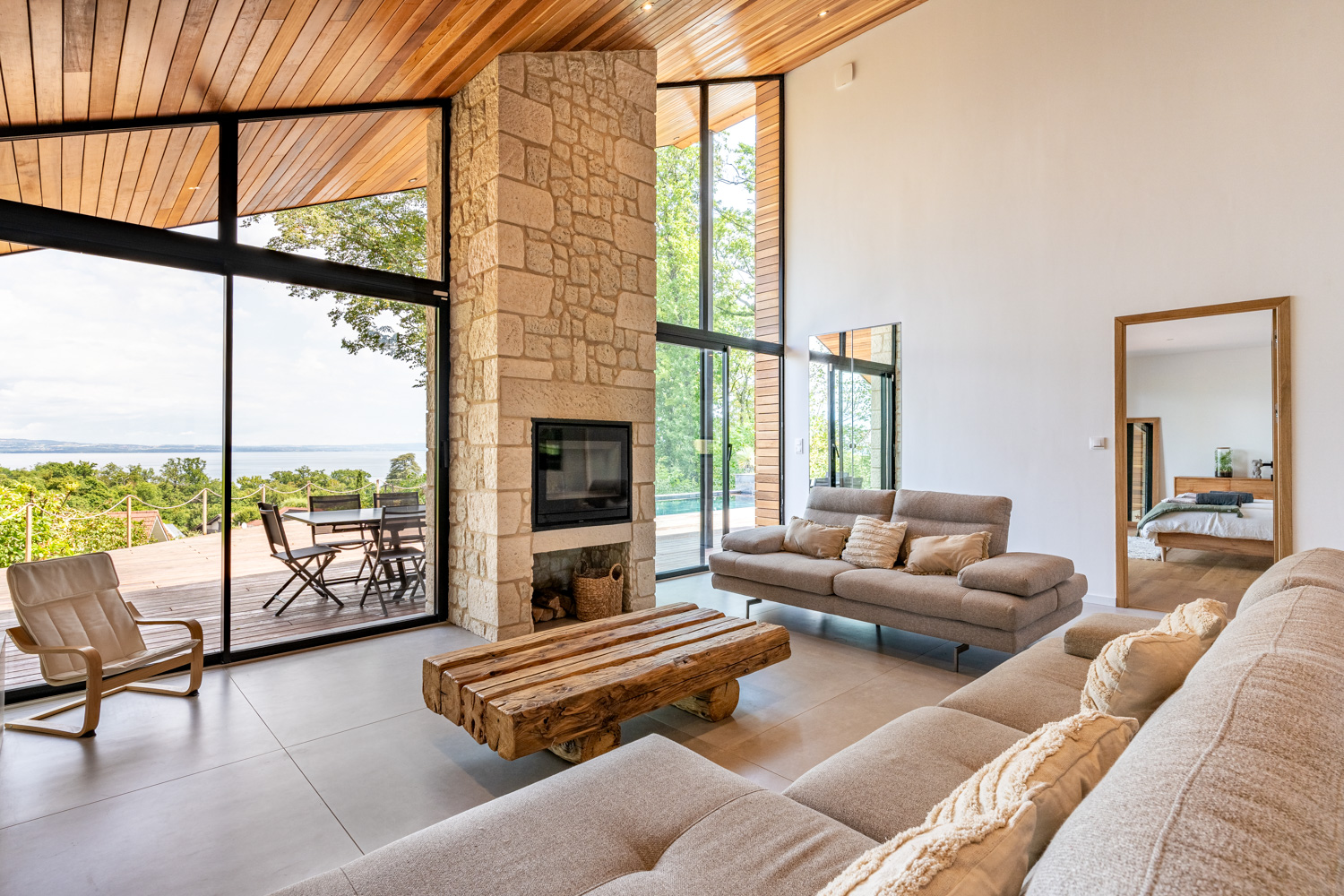
Modern living room with natural Rocky Mountain wall cladding and champagne coffee table
Rocky Mountain natural tone

Orsol wall cladding: innovation and a mineral signature

Creating an accent wall also means making a strong architectural choice. Orsol cladding meets precisely this ambition, combining visual depth, quality of finish and assertive materiality. They introduce a play of shadows, textures and nuances that give the wall an active presence in the room.

Orsol designs all its collections around a dual commitment: preserving the mineral character of the materials and offering solutions adapted to every style of interior design, from the most traditional to the most contemporary. Each cladding is designed as an architectural piece in its own right, conceived to interact with light and the environment.

This richness is also based on a major innovation: NEOMINERAL® material, a low-carbon alternative that’s strong, durable and environmentally friendly.

How to create an accent wall with Orsol siding

Creating a successful accent wall is not something you can improvise. Beyond the choice of model, it’s the rigorous application that guarantees a convincing final result. Orsol provides clear, easy-to-understand recommendations to help both private individuals and professionals install siding according to the rules of the trade.

1. Choose the right wall

The first step is to select the most relevant wall section according to the room’s configuration. Often, it’s the one you see as you enter, or the one that serves as a backdrop for a strong piece of furniture (sofa, table, bed), or the one that creates a defined area (reading corner, dining area). The surface must be sound, flat, clean and dry.

2. Preparing the substrate

It’s essential to identify the type of wall (breeze block, concrete, plasterboard, etc.) in order to adapt the installation products. Orsol recommends the use of ORFLEX High Performance adhesive. Good layout is also essential: lay out the panels in a blank to visualize the distribution and anticipate cuts.

3. Gluing the plates

Installation begins at the bottom of the wall, with three rows per day. INFINITY cladding, for example, comes in large sheets (80 x 47.5 cm) to be glued horizontally.

4. Joints and finishes

For models with joints, such as INFINITY, a special mortar is used. Once dry, the joint can be lightly scraped to create a more natural look. Slabs should be protected with a suitable water repellent, especially in damp or exposed rooms. This treatment ensures the durability of the cladding, and should be renewed every five years or so.

5. Gentle care

Regular, gentle cleaning is all it takes to preserve the wall’s appearance over the long term.

For corners, if the chosen cladding does not have specific elements, they can be made manually from the panels, according to the recommendations in the Orsol technical specifications.

Renovating your facade: giving your home a new look

Inspiration 25 Aug 2025
Poser du parement ORSOL

The façade is much more than just the “face” of your home. It reflects the architectural style of your home, provides protection from the elements and helps to enhance the value of your property. Over time, exterior walls can deteriorate: cracking, soiling, discoloration or delamination of plaster. Renovating a house facade is both a technical necessity and an aesthetic opportunity.

Why renovate a facade?

Renovating an exterior wall is about more than just aesthetics. A damaged facade can let in moisture, weaken insulation and, ultimately, jeopardize the structure of the building. Renovating a facade is also an opportunity to improve thermal comfort, especially when accompanied by external insulation, a real asset for saving energy.

Beyond these technical aspects, a well-kept facade helps to enhance the value of your property. A well-maintained house inspires confidence and attracts future buyers more easily. Last but not least, we mustn’t overlook the regulatory aspect. In some communes, repainting is compulsory at regular intervals, or is subject to aesthetic constraints, particularly in protected heritage zones.

In short, renovating a house facade not only preserves your investment, but also reinforces the architectural harmony and character of your home.

How to renovate a facade: the essential steps

Renovating a facade involves several essential stages:

1. Diagnosis

Before starting façade renovation, it’s essential to identify the condition of the wall. Cracks, stains, moss or loose plaster: each problem calls for a specific solution. This is also the time to check whether any structural work is required.

2. Cleaning

Thorough cleaning removes dirt and encrusted vegetation. Depending on the fragility of the substrate, different techniques can be used, such as water repellency, gentle sanding or manual brushing.

3. Wall repair

If you’re wondering how to renovate a damaged wall, you should know that cracks must be filled and fragile areas consolidated before any finishing work is carried out. This ensures the durability of the new coating.

4. Laying new flooring

This is the step that will transform the appearance of your home. Ecological wall cladding, decorative plaster or cladding, the choices are numerous.

Large country house with Causse siding from ORSOL
Causse ORSOL collection on large country house

ORSOL solutions for renovating house facades

A recognized specialist in home and garden enhancement, ORSOL designs and manufactures in France a complete range of architectural elements in reconstituted stone. Among its creations, wall facings occupy a place of choice. They add relief and character to facades, whether to give a contemporary style to a recent house or to preserve the rustic charm of an old building. Pillars and wall caps add structure to exteriors, highlighting entrances and elegantly defining gardens.

What styles are best for renovating an exterior wall?

Renovating a wall doesn’t just mean restoring it: it’s also an opportunity to rethink its architectural identity. A facade, for example, can adopt a contemporary style, with clean lines, sober colors and mineral-finish cladding to give it a modern, elegant look. Others prefer to preserve the authenticity of their home by opting for a more traditional ambience, notably with imitation ashlar cladding, particularly well-suited to older homes. You can also opt for a natural design by combining reconstituted stone and wood, a combination that brings warmth and character to the exterior.

Bioclimatic house with wood cladding and natural tone Brécy siding from ORSOL

Facade renovation and legal obligations

Before renovating an exterior wall, it’s essential to check with your local town hall. In some communes, town-planning regulations impose specific color and material choices to preserve local architectural harmony. When the home is located in a listed area or near a historic monument, prior approval from the Architectes des Bâtiments de France may also be required. What’s more, some facade renovation projects are subject to a preliminary declaration of works, an essential administrative procedure to guarantee the conformity of the project.

Respecting these obligations helps avoid any disputes and ensures that the project blends seamlessly into its surroundings.

How to give character to your terrace wall?

Inspiration 11 Aug 2025
Maison moderne recouvert du parement Portland ton naturel de chez ORSOL

A visual landmark in the design of a terrace, the exterior wall organizes the space. Dressed in carefully chosen mineral-textured claddings and hues, it becomes a medium of architectural expression, capable of harmonizing the whole and extending the house’s identity into the garden.

Why clad a terrace wall?

Well thought-out and dressed with the right materials, a terrace wall can define volumes, guide the eye and protect the structure over time.

Structuring space and creating perspectives

An exterior wall plays an essential role in the composition of a terrace. It delimits volumes and creates visual axes that organize the layout. By working with its textures and shades, it becomes a real staging tool, capable of reinforcing perspectives andadding depth.

Protecting and enhancing terrace space

Beyond its visual appeal, cladding helps protect a wall. Exterior cladding forms a barrier against the elements and limits the effects of humidity, which can weaken the structure over time. The choice of suitable materials, designed to withstand climatic variations, guarantees optimum durability while adding an extra touch of cachet to the whole.

Spacious, light-filled pool house with stone wall

What materials to choose for an exterior wall?

Facing stones, bricks or concrete effects: each solution offers a distinct look and responds to specific technical constraints.

The timeless character of facing stone

Appreciated for their natural rendering and ability to blend into a variety of environments, facing stones add relief and authenticity. Orsol collections such as Rocky Mountain, Causse and Roca are distinguished by their mineral textures and subtle hues, which interact with the surrounding vegetation and architecture. They are designed for outdoor use, ensuring excellent resistance to climatic variations.

modern villa in Spain with modern terrace with swimming pool, large table to welcome guests, wooden floor, wall cladding Incerto ORSOL

The raw spirit of bricks and the sobriety of concrete

For projects with an assertive style, facing bricks feature warm tones and reliefs reminiscent of industrial style. They are ideal for creating accent walls or adding character to a contemporary terrace.

Conversely, concrete-effect cladding such as Infinity seduces with its clean lines and mineral tones. They are particularly suited to modern architecture, which favors sobriety and geometric shapes.

Ideas for sublimating terrace wall cladding

The materials used can be enriched by additional features that enhance the wall’s integration into the exterior space.

Combining mineral and vegetable matter

The combination of stone or brick facings with climbing plants or hanging planters creates a living wall, where the rigidity of the mineral material contrasts with the suppleness of the vegetation. This composition adds depth and a more organic atmosphere to the terrace.

bright, modern terrace staircase with olive trees

Working with light effects

Well-thought-out lighting can reveal the relief of wall cladding, transforming the atmosphere as soon as night falls. Recessed spotlights, wall lights or LED ribbons can accentuate textures and enhance wall volumes, while offering appreciable visual comfort.

Creating customized atmospheres

The choice of colors and textures opens the way to a multitude of styles. Warm tones and solid volumes evoke a Mediterranean spirit. Bricks take on an industrial feel, while the sober lines and neutral tones of facing stones are perfect for minimalist, contemporary terraces.

Cladding a terrace wall gives it a structuring role and a presence that defines the space. With their textures and assertive lines, Orsol collections extend this architectural élan.

Pool surrounds, in rock-tone ORSOL Tahoe neomineral stone cladding

The impact of facade materials on buildings’ carbon footprint

Inspiration 17 Feb 2025

Low-carbon facade materials play a decisive role in reducing the environmental impact of buildings. With the NÉOMINÉRAL® innovation, Orsol offers a high-end cladding solution compatible with low-carbon construction projects.

The low-carbon principle

Low-carbon neighborhoods, architecture and equipment: all these projects have in common the reduction of greenhouse gas (GHG) emissions throughout their lifecycle.

How to assess the environmental impact of materials?

A material’s life cycle extends from the moment it is collected or extracted to the moment it is recycled, recovered or reused after the building has been demolished.

In the meantime, the material will have been transformed, using processes that are more or less energy-intensive and/or polluting. It will have been transported, with an inevitably higher carbon footprint for resources geographically distant from the construction site.

The ultimate low-carbon material is one that is produced locally, undergoes little processing and can be easily recycled at the end of its life cycle. The conditions of installation are not insignificant either.

Exemplary projects in this field rely heavily on off-site assembly to reduce constraints and lead times, and consequently the number of carbon-intensive return trips made by professionals.

The weight of materials in a building’s carbon footprint

On a building scale, materials have a major impact. The least eco-responsible materials have production processes that consume fossil fuels and water. This is the case with aluminum and steel, which consume a lot of energy and water for cooling. The use of recycled metals is a good way of minimizing this footprint.

It is also possible to mobilize materials whose initial production process is more virtuous. These include bio-sourced and geo-sourced materials such as wood and natural stone . Favoring these locally available resources is an essential lever for reducing greenhouse gas emissions.

The role of facades in reducing carbon emissions

The carbon weight of the façade has been estimated at between 8% and 25% of the building’s total footprint. A considerable share calculated on the basis of several multi-family housing and office construction projects, as part of a study by the French Institute for Building Performance (Ifpeb) and the Carbone 4 consultancy, published in 2022.

The study reveals several ways in which facades can improve their carbon footprint. The use of less carbon-intensive materials is naturally encouraged, underlining the environmental impact of the type of exterior cladding, but architectural choices also play a role.

Glass walls are both more carbon-intensive and less decarbonizing. In other words, the prospects for optimizing the energy efficiency of a generously glazed building are slimmer. Here,traditional architecture seems to come out on top, with glazing-efficient facades and the use of locally available materials.

RE2020 2025 threshold requirements

The RE2020 environmental regulation provides for new emission thresholds to be phased in by 2031 to encourage low-carbon construction. The aim is to reduce the sector’s GHG emissions by 30%.

The facade and its external joinery are among the batches taken into account in the calculation of the IC construction indicator to assess the impact of products and equipment used on a building site on the environment.

Between 2022 and 2024, the maximum value of the CI for house construction was 640 kilograms of CO2 equivalent per square meter (kg CO2 eq/m²). It falls to 530 kg CO2 eq/m² for the period 2025 – 2027, reaching 415 kg CO2 eq/m² by 2031.

NÉOMINÉRAL®, Orsol’s low-carbon cladding solution

Orsol, a specialist in top-of-the-range cladding made in France, offers creative and innovative solutions that enhance characterful architecture and the unique charm of natural stone. Thanks to the composition and production conditions of its NÉOMINÉRAL® material, Orsol offers an alternative for low-carbon building facades.

Composed of 99% mineral-based materials, its various colors are obtained using natural pigments. The cold production process, based on the pozzolanic reaction, maintains a low level of CO2 emissions. Production waste and water are fully recycled.

Manufacturing in the Nouvelle-Aquitaine region reduces transport-related emissions. Orsol’s suppliers are all European, and 93% are based in France. The installation system, validated by the CSTB, is simple and complies with the performance requirements expected in the construction industry.

NÉOMINÉRAL® responds to the need for low-carbon materials capable of meeting the increasingly stringent environmental impact requirements of the building industry.

How can you add warmth to your wall decor?

Inspiration 14 Jan 2025
causse sur treillis

In winter, more than ever, the home is our comfort zone. This season’s decor should make you want to curl up in the coziest corners of the house. The materials to favor are wood, velvet, wool… In other words, avoid anything that conveys cold or the idea of cold. To take things a step further, you can dress your interior walls with cocooning coverings that meet these criteria. Here are a few ideas.

Decorating ideas for a warm living room

Orsol, a specialist in low-carbon stone, offers top-of-the-range cladding products for every room in the house. For a warm living room, textured red brick is a must, while smooth stone goes easily with contemporary interiors.

Textured red facing brick near the fireplace

The natural hues of brick are perfectly reproduced by Orsol facings. Non-flammable, these products can be installed quickly and easily behind a stove or around a fireplace insert. Nevertheless, a few precautions must be taken to ensure proper installation. The Orsol team is at your disposal to answer any questions you may have. You’ll also find advice and best practices in this article on installing cladding behind a heat source.

Smooth stone finishes for contemporary warmth

It’s not easy to create coziness in a contemporary interior. Generous volumes, large bay windows, the cool aesthetic of metal and raw materials… At first sight, this style is in opposition to rustic architecture and its small cottage or country house-style interiors. To bring warmth to these modern spaces, you need to play with furniture, accessories (curtains, plaids, cushions…), lighting and coverings. In the Orsol collection, smooth-finish facing stones such as Bercy or Infinity are ideal for bridging the gap between modernity and conviviality.

Cosy and comforting bedroom furnishings

In bedrooms, your cozy bedding will ideally be framed by a textured stone accent wall to give the room relief. The idea is to move away from aseptic walls and avoid uniformity of shape and color.

Several Orsol solutions meet this challenge with irregular stones and a variety of colors in warm shades. The Causse and Manoir collections offer reconstituted stone in a variety of sizes and harmonious shades, starting with a “sienna” or slightly darker “rose red” tone.

Collection Causse ton naturel – @noemie_instantcosy

The Meulière collection also offers a variety of colors and stone sizes, but with the deeper reliefs characteristic of meulière stone. The rubble look and shell-like reliefs are ideal for decorating a cosy bedroom in winter.

Original, easy-care kitchen surfaces

The kitchen is a convivial space that must above all remain functional. So, a warm winter decor, yes, but not at the cost of brightness.

Aged limestone is ideal for adding depth while reflecting light. With the Causse collection on trellis, the stones are assembled seamlessly in highly instinctive, irregular patterns. Shades range from “natural” to “golden beige” for clarity. Ideal for a rustic kitchen.

causse on trellis

For more contemporary, but no less cozy interiors, the Cubik collection is a good option. It, too, brings a dose of irregularity, but with rectangular-shaped stones. A fine balance between raw texture and controlled form, reminiscent of the geometric volumes of modern buildings.

Living room with wall cladding in natural-tone Cubik sheet from ORSOL, wall-mounted TV.
Cubik ton naturel – @une_villa_au_soleil

Easy to maintain, Orsol siding can be cleaned to preserve its original appearance, even in rooms prone to soiling.

Traditional architecture and regional facings

Inspiration 20 Dec 2024
maison avec façade en pierre

A return to the architecture of traditional houses has become a necessity in a context where local resources and know-how are valued. These best practices, partly handed down through use, constitute a heritage rooted in the region, and a new source of inspiration for designing naturally resilient buildings.

This is reflected in facade cladding trends, with a pronounced taste for references to locally available materials. Here are some ideas for applying Orsol cladding in regional styles.

Collection Meulière, a nod to Parisian mansions

Millstone was the emblematic material of 19th-century and early 20th-century middle-class homes in the Paris region. It is also found in the richly ornamented villas of the Art Nouveau style. These characterful buildings are also known as meulières or maisons meulières.

Driven by its passion for stone, Orsol seeks to revive this unique character with its reconstituted stone solutions from the Meulière Collection. The result is perfect, with a product that’s reliable, resistant, more flexible and easier to install for Meulière house-inspired cladding.

Photo credit: Thomas Behuret

Collection Causse: dry stone in Quercy

The Quercy Basin, rich in limestone plateaux, also known as the Causses du Quercy, has given rise to a picturesque architecture, recognizable by its typical houses with adjoining turrets, corbelled tiles (génoise) and covered stoops (bolets). Dry limestone and its naturally ochre tones are inseparable from this style and, more broadly, from the architecture of traditional houses in the South-West.

Orsol’s Causse Collection takes up this singular aesthetic with reconstituted stone in elongated shapes with a fine grain and soft relief, available in natural, sienna or golden beige hues.

Angles collection Causse
Photo credit: Ludovic PLAULT

Tertus Collection: the stacked dry stones of Bonifacio

Corsica’s building tradition reflects the richness of its soils: schist on the Cap Corse peninsula, granite further south and limestone in the Bonifacio region. The local heritage includes exposed stone facades with dry stone dressings, sometimes dry-mounted without mortar.

To recreate this stacked look, also found on low walls and exterior walls, Orsol offers reconstituted stone cladding from the Tertus Collection, available in natural, shaded beige and golden beige tones.

Photo credit: Corinne Godard

ROCA Collection: for mountain refuges

At high altitude, local people have made do with the resources of the land, mainly wood and stone. Although these materials are locally abundant, they are not necessarily readily available. Smaller stones may have facilitated transport and played a role in traditional mountain architectural styles. The use of stones in a wide variety of sizes also reflects the need to make the most of all available resources.

The Roca Collection reflects this approach to home architecture, with great variation in both the size of the stones and the shades of each of the reconstituted stones assembled on a ready-to-install lattice.

What about the granite of Breton houses and the shelters that line coastal paths? Orsol is currently working on the launch of a new Granite Collection in 2025 for the reconstituted stone facings of typical Breton houses.

A mountain chalet with "Roca" cladding by ORSOL is nestled in a snowy landscape. The chalet features a harmonious combination of natural wood and gray stone cladding, giving it a rustic yet elegant appearance.

Natural or reconstituted stone: which to choose?

Inspiration 18 Oct 2024
Villa sur le lac dotée de la Collection MANITOBA

To make the right choice, it’s important to understand the difference between natural and reconstituted stone. The former is derived from rock extracted from its natural environment, while the latter is reconstituted to reproduce its appearance, while offering greater freedom and simplicity in terms of installation conditions, personalization and maintenance.

The difference between natural and reconstituted stone

Reconstituted stone takes on some of the characteristics of the rock it imitates: mechanical properties, authentic appearance… However, it offers much greater flexibility for interior and exterior wall cladding.

What is natural stone?

Natural stone comes from rock formed progressively by the assembly of minerals. These rocks are used in construction for their strength, or in decoration for their aesthetic qualities.

Marble, sandstone, slate and granite are just a few examples of the natural stones that are regularly used for a variety of building projects. Of course, the raw material undergoes a number of transformations so that it can be used as intended, but these adjustments are minimal.

The brand NOVIROC brand will unveil an exclusive collection of natural stones in 2025. These stones will offer exceptional aesthetic solutions for a variety of architectural projects.

What is reconstituted stone?

Reconstituted stone is obtained from mineral aggregates bonded and molded to the desired finish. After reconstitution, the block can be cut and polished like a stone extracted directly from its natural environment.

Our mastery of the process results in highly realistic reconstituted stones with subtle hues that can be customized to meet the needs of a particular project and geographical area, for example.

A mountain chalet with "Roca" cladding by ORSOL is nestled in a snowy landscape. The chalet features a harmonious combination of natural wood and gray stone cladding, giving it a rustic yet elegant appearance.

Orsol specializes in the manufacture ofhigh-end architectural elements from reconstituted stone. Discover our range of interior and exterior reconstituted stone cladding.

What are the advantages of reconstituted stone?

Reconstituted stone offers three major advantages: strength, flexibility and durability.

A stone reconstituted according to the constraints of the terrain

Reconstituted stone is designed to adapt to its installation environment. At Orsol, cladding can be interior or exterior, thanks to slabs that are resistant to external aggression, UV rays, damp rooms…

The look of natural stone wall cladding

The product can also meet precise aesthetic criteria to match the architectural style of the house or an existing natural stone cladding. In fact, it’s possible to reproduce the look of natural stone wall cladding, without the associated constraints.

Poolside cladding

Simplified implementation

Thanks to their thinness and lightness, Orsol siding is very easy to install. This solution avoids loss of living space, particularly dreaded when it comes to cladding the smallest rooms in the home. Orsol has developed its IDEAPOSE® installation process, which now benefits from an Avis Technique.

A low-carbon alternative

The environmental impact of natural stone cladding can be higher, due to the extraction and transportation processes involved. Since 2023, ORSOL has been offering a sustainable, eco-responsible alternative, with a reliable, low-carbon footprint solution. Discover NEOMINERAL®, the new low-carbon material designed to meet today’s sustainable construction challenges.

Industrial decoration: concept and ideas

Inspiration 16 Sep 2024
Brique ton rouge en pierre a pierre de chez ORSOL avec poêle à bois devant

Where does industrial style come from? What are its current codes and how can we adapt them to our contemporary needs to create an aesthetically pleasing and functional interior that’s in tune with today’s tastes?

The birth and essence of industrial style

The Latin etymology of the term “industry” already provides the basis for the industrial architectural style. Industria can mean activity, strength or energy. All concepts that changed the shape of buildings during the Industrial Revolution.

An architecture of rationality

Factories and warehouses built in the 19th century had only one objective: functionality. Ceiling heights were determined by machine dimensions. Glass walls ensure sufficient light to illuminate workstations. The layout is designed to enhance productivity. The choice of furniture, practical and basic, meets the same expectations of optimizing the work force, saving resources, space and energy.

A style that attracts in spite of itself

The industrial approach to the building’s design was not intended to seduce, only to rationalize the available surface area. Unwittingly, it delivered spaces that were to delight trendsetters. In the 1970s and 1980s, booming cities like New York gave a second life to industrial premises. These properties, with their generous volume and abundant light, became highly sought-after artists’ studios. The ultra-practical furniture they contain is used as is. Industrial style takes on a new dimension and becomes a fashion trend.

Contemporary industrial style

Most of the designs we find today in business premises and private homes are versions adapted to the needs and demands of the contemporary world. New industrial furniture is a less austere, more comfortable variation on the original style. Skylights and large glass walls are installed according to current design standards. Cladding is relatively similar, left unfinished, but with a concern for eco-responsibility and durability that takes precedence over the economic aspect.

6 ways to create contemporary industrial style

The industrial style has been brought up to date to meet new needs. Some are purely practical: more space, more storage, fewer constraints… Others are ethical and aesthetic: the search for a certain authenticity, the reuse of objects and the valorization of materials… Generally speaking, contemporary industrial style is personalized, unlike the original approach, which was purely productivist and uniform.

1 – Old red facing brick walls

Raw brick walls are an ideal backdrop for creating an industrial-inspired interior. Now, thanks to Orsol wall facings, it’s possible to recreate the authentic look of brick without the constraints of installation and maintenance. Orsol, based in the Nouvelle-Aquitaine region of France, favors short circuits and local sourcing to deliver more sustainable products with low environmental impact, integrating ethics and design.

The five ORSOL brick collections, Brick, Old School, Briquette, Chromatikand Black and Whiteoffer a wide range of shades and textures to enrich an industrial-style interior. From aged red tones to black and white bricks and modern accents, each collection adds its own unique touch.

A concrete example of this diversity is Élodie and Joan’s project, where red brick was chosen to frame a stove and bookcase. This project perfectly embodies the industrial aesthetic, creating a warm yet authentic atmosphere inspired by Anglo-Saxon lofts.

Photo credit: @thecountryglasshouse

BRIKELIA terracotta bricks add authentic character to any interior, harmoniously blending industrial spirit and modernity. Each vintage brick, unique in its texture and relief, is a reused brick that constitutes a fragment of history. They enrich contemporary spaces with warmth and originality.

Living room with skylight base clad in red-tone Vintage Rectified BRIKELIA siding

2 – Large volumes

Since you have a choice of brick colors, you can opt for lighter tones to maximize the feeling of space. Keeping one or more wall sections completely clear is another way of creating a sense of volume, essential for reproducing the industrial style. Decompartmentalize if technical conditions allow.

3 – Natural light

To encourage natural light, create gaps around windows and install mirrors in the right places. Locate solid partitions that could be replaced by skylights. Wherever possible, remove any obstacles to light diffusion .

4 – Artificial light

When night falls, you need to be able to rely on focused points of light to illuminate useful surfaces. This is the rationality of the industrial style. Instead of a ceiling light that illuminates the whole room, install spotlights, or better still, workshop-style light bulb suspension cables, above the kitchen worktop, dining table or desk.

5 – Industrial-style storage

To make room, you need storage solutions. Visible storage solutions can take the form of trendy lockers. They can be taken from the staff checkroom installed in factories. If this is an original piece of furniture, it will be useful to renovate it by adding shelves, so that it can be of real interest in the organization of a contemporary interior.

6 – Exposed piping

In industrial buildings, piping networks, pipes and machine gears are not concealed. If your interior includes exposed piping, highlight it with a metallic paint that contrasts with the color of your Orsol brick veneer wall.