Skip to content

Renovating your facade: giving your home a new look

Inspiration 25 Aug 2025
Poser du parement ORSOL

The façade is much more than just the “face” of your home. It reflects the architectural style of your home, provides protection from the elements and helps to enhance the value of your property. Over time, exterior walls can deteriorate: cracking, soiling, discoloration or delamination of plaster. Renovating a house facade is both a technical necessity and an aesthetic opportunity.

Why renovate a facade?

Renovating an exterior wall is about more than just aesthetics. A damaged facade can let in moisture, weaken insulation and, ultimately, jeopardize the structure of the building. Renovating a facade is also an opportunity to improve thermal comfort, especially when accompanied by external insulation, a real asset for saving energy.

Beyond these technical aspects, a well-kept facade helps to enhance the value of your property. A well-maintained house inspires confidence and attracts future buyers more easily. Last but not least, we mustn’t overlook the regulatory aspect. In some communes, repainting is compulsory at regular intervals, or is subject to aesthetic constraints, particularly in protected heritage zones.

In short, renovating a house facade not only preserves your investment, but also reinforces the architectural harmony and character of your home.

How to renovate a facade: the essential steps

Renovating a facade involves several essential stages:

1. Diagnosis

Before starting façade renovation, it’s essential to identify the condition of the wall. Cracks, stains, moss or loose plaster: each problem calls for a specific solution. This is also the time to check whether any structural work is required.

2. Cleaning

Thorough cleaning removes dirt and encrusted vegetation. Depending on the fragility of the substrate, different techniques can be used, such as water repellency, gentle sanding or manual brushing.

3. Wall repair

If you’re wondering how to renovate a damaged wall, you should know that cracks must be filled and fragile areas consolidated before any finishing work is carried out. This ensures the durability of the new coating.

4. Laying new flooring

This is the step that will transform the appearance of your home. Ecological wall cladding, decorative plaster or cladding, the choices are numerous.

Large country house with Causse siding from ORSOL
Causse ORSOL collection on large country house

ORSOL solutions for renovating house facades

A recognized specialist in home and garden enhancement, ORSOL designs and manufactures in France a complete range of architectural elements in reconstituted stone. Among its creations, wall facings occupy a place of choice. They add relief and character to facades, whether to give a contemporary style to a recent house or to preserve the rustic charm of an old building. Pillars and wall caps add structure to exteriors, highlighting entrances and elegantly defining gardens.

What styles are best for renovating an exterior wall?

Renovating a wall doesn’t just mean restoring it: it’s also an opportunity to rethink its architectural identity. A facade, for example, can adopt a contemporary style, with clean lines, sober colors and mineral-finish cladding to give it a modern, elegant look. Others prefer to preserve the authenticity of their home by opting for a more traditional ambience, notably with imitation ashlar cladding, particularly well-suited to older homes. You can also opt for a natural design by combining reconstituted stone and wood, a combination that brings warmth and character to the exterior.

Bioclimatic house with wood cladding and natural tone Brécy siding from ORSOL

Facade renovation and legal obligations

Before renovating an exterior wall, it’s essential to check with your local town hall. In some communes, town-planning regulations impose specific color and material choices to preserve local architectural harmony. When the home is located in a listed area or near a historic monument, prior approval from the Architectes des Bâtiments de France may also be required. What’s more, some facade renovation projects are subject to a preliminary declaration of works, an essential administrative procedure to guarantee the conformity of the project.

Respecting these obligations helps avoid any disputes and ensures that the project blends seamlessly into its surroundings.

Embellishing your garden with stone cladding: uses and tips

Inspiration 06 Jun 2025
Espace extérieur avec habillage de parement Rocky Mountain ton gris nuancé

There’s much more to garden design than the choice of plants. It’s about organizing space, structuring circulation, composing volumes and materializing limits or uses. In this respect, stone is a material of choice. Its character, strength and versatility allow it to be used in a wide range of ways to personalize the key elements of outdoor spaces.

Low walls and pillars: a visual signature right from the entrance

For a contemporary housing estate, as for a character house in a rural area, the entrance area is an important threshold in the interpretation of the project. Installing low walls or pillars clad in stone helps define the transition point between private and public space, while adding unique architectural value.

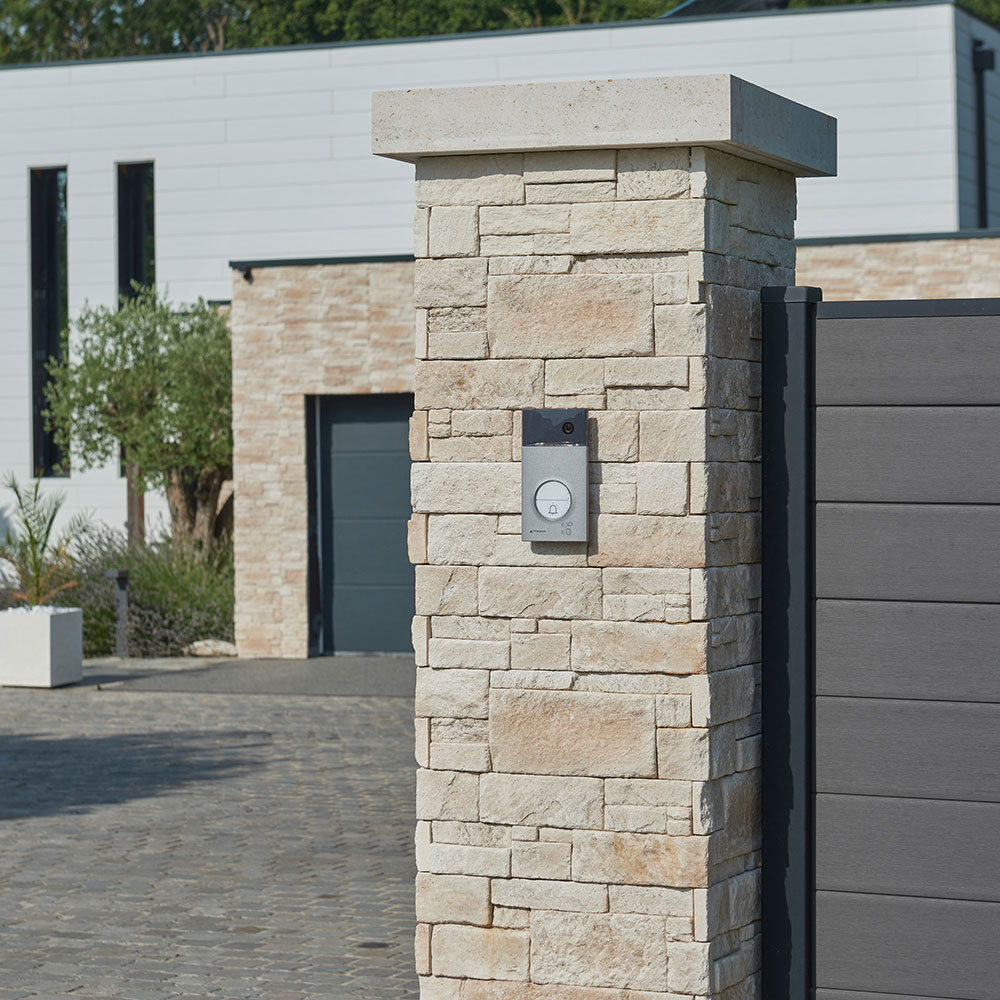
Pillar in natural-tone Cubik cladding

Delineating space with elegance

Low entrance walls and stone-clad pillars help to structure access to a property, while at the same time asserting its architectural identity. They can frame a gate, support a fence or simply delimit the main access.

Integrating functional elements

Walls can be built in breeze-block or concrete, then clad with facing slabs for a hard-wearing finish. The addition of wall caps and corner elements in the same material ensures a harmonious result. Pillars, meanwhile, can be fitted with automatic gate operators or integrated lighting fixtures.

Patio wall or privacy screen: creating privacy without stifling space

In urban or peri-urban settings, overlooking can have an impact on the comfort of outdoor spaces. Rather than a plant screen that takes time to develop, a privacy wall clad in stone cladding ensures the immediate privacy of a patio or terrace. The friendly charm of the material helps to avoid the feeling of compartmentalization.

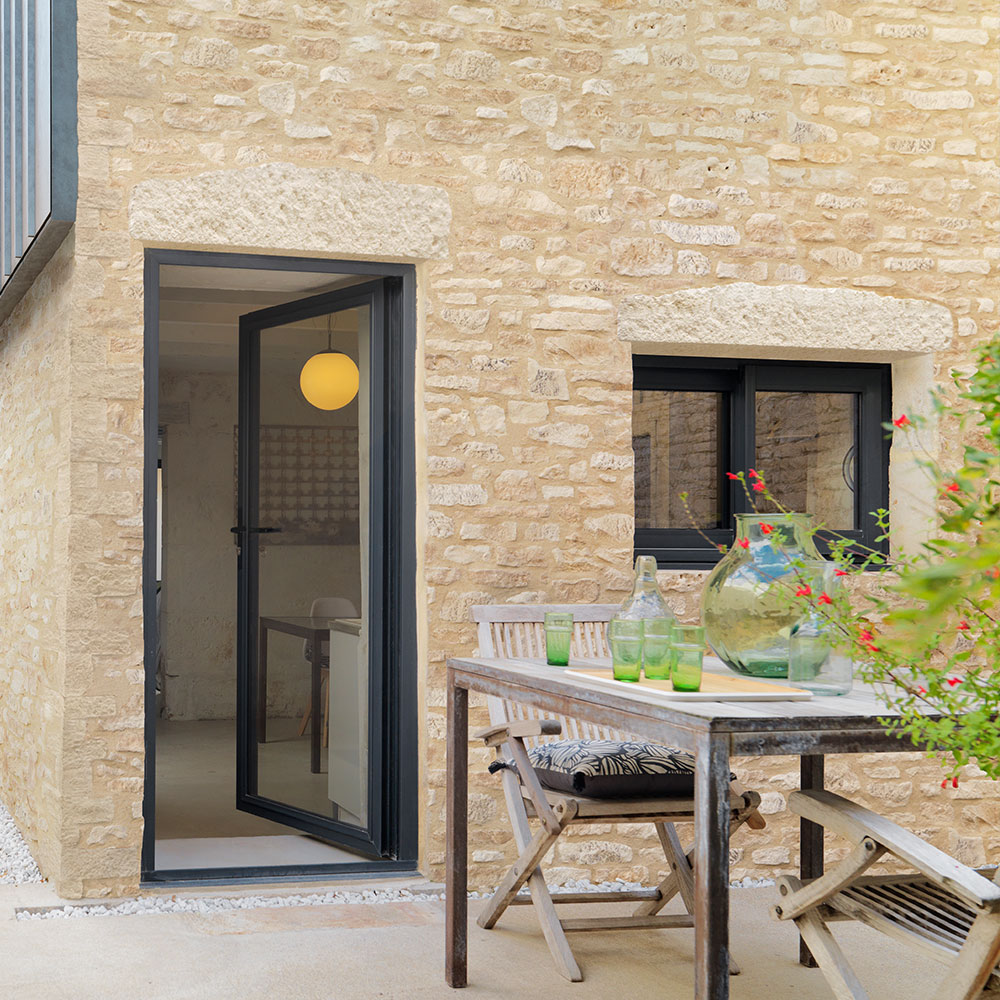
Exterior facade in natural-tone Causse cladding stone with outdoor furniture

Preserving the privacy of the private garden

Dividing walls and privacy screens with stone cladding are a durable solution that is both technical and decorative. They provide privacy while creating a warm atmosphere and respecting the natural setting of the outdoor space.

Creating harmony outdoors

Unlike a simple fence or blackout panel, a wall clad in textured stone creates relief, catches the light and contributes to the overall ambience of the garden. The material effect and natural nuances of the cladding create a strong visual dialogue with the surrounding vegetation.

Tips: to brighten up shady areas or enlarge a narrow patio, opt for a light stone finish in soft beige or grey tones, such as Orsol Causse stone in natural tone, or Manoir cladding in stone tone.

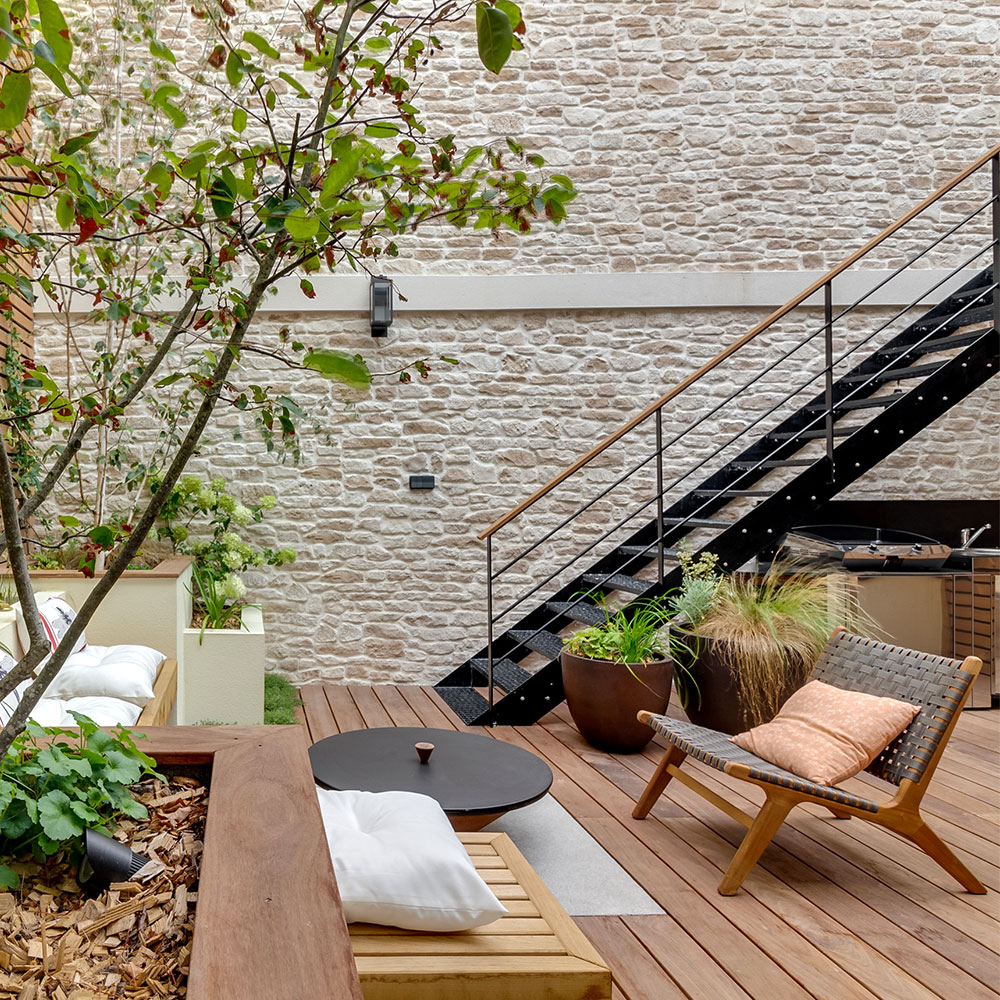
Outdoor wooden terrace with large wall in Causse cladding from ORSOL

Stone planters: structuring plant space

Planters play a structuring role in garden design: they delimit zones, establish a hierarchy of heights and contribute to the overall plant aesthetic. The use of stone cladding can harmonize these elements with other garden walls.

Showcasing plants

Stone clad planters are ideal for structuring gardens and showcasing plants. They can be used to create flower beds, raised vegetable gardens or simply to add a touch of color and evolution to garden decoration with stone cladding.

Ensuring visual consistency

In both contemporary projects and regionally-inspired renovations, stone planters create a stylish continuity between buildings, paths and planted areas. Thanks to the modularity of the cladding slabs, it’s possible to adapt the shapes (square, rectangular, rounded) and dimensions of the stones for greater precision in the finish.

Fence wall: the regulatory garden boundary

The fence of a garden or property marks the separation, but also the identity of the site from the public space. Dressing a boundary wall with stone cladding combines charm and robustness, in keeping with traditional local architecture.

Securing and enhancing property value

A stone-clad enclosure wall is a durable, hard-wearing solution that enhances the overall appearance of your exterior. It provides security and privacy while blending seamlessly into the landscape environment.

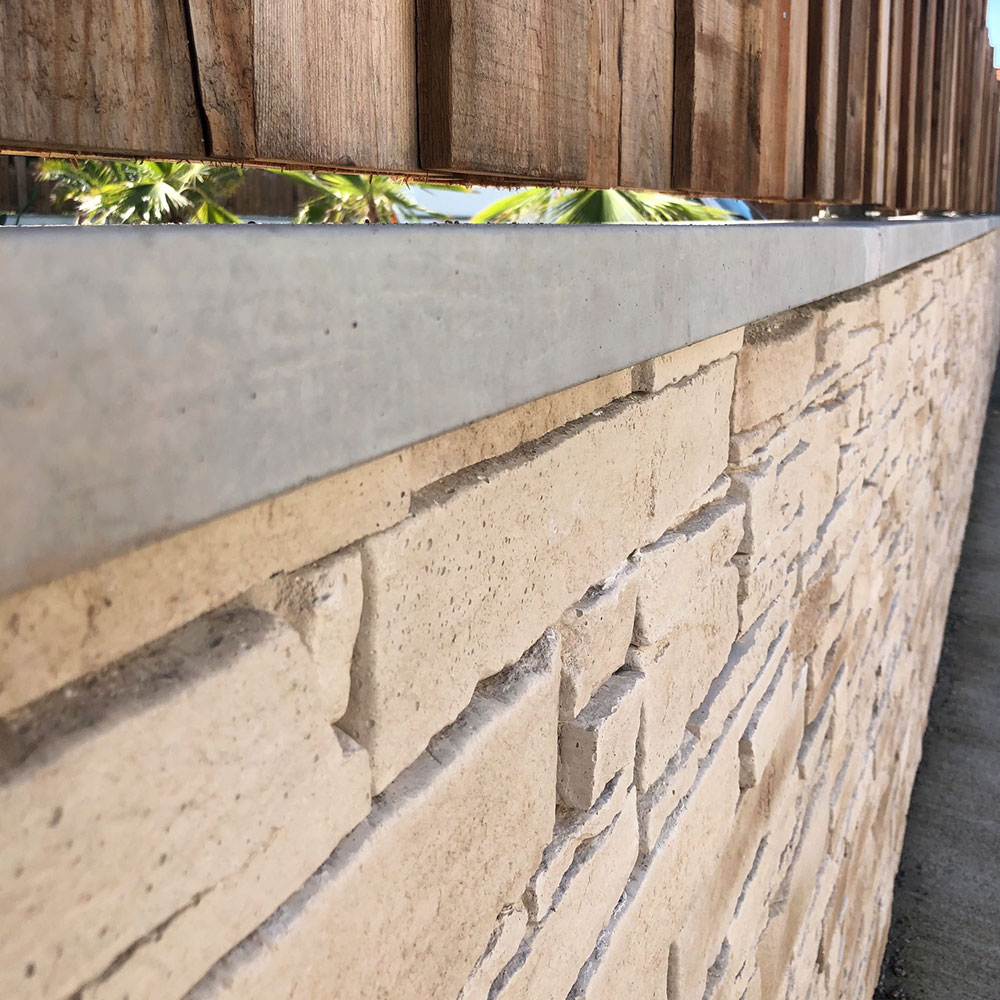
Rocky Mountain natural tone cladding garden wall with wooden fence

Comply with current regulations

French regulations govern the construction and height of mineral fences. This means that, depending on the locally applicable PLU, you may be required to obtain a prior declaration of works.

Stone terraces: with reference to existing structures

Terraces are the heart of outdoor living. Choosing a material that is consistent with the architecture of the house is a prerequisite for successful integration. Stone slabs or floor coverings matching the vertical facings unify the whole.

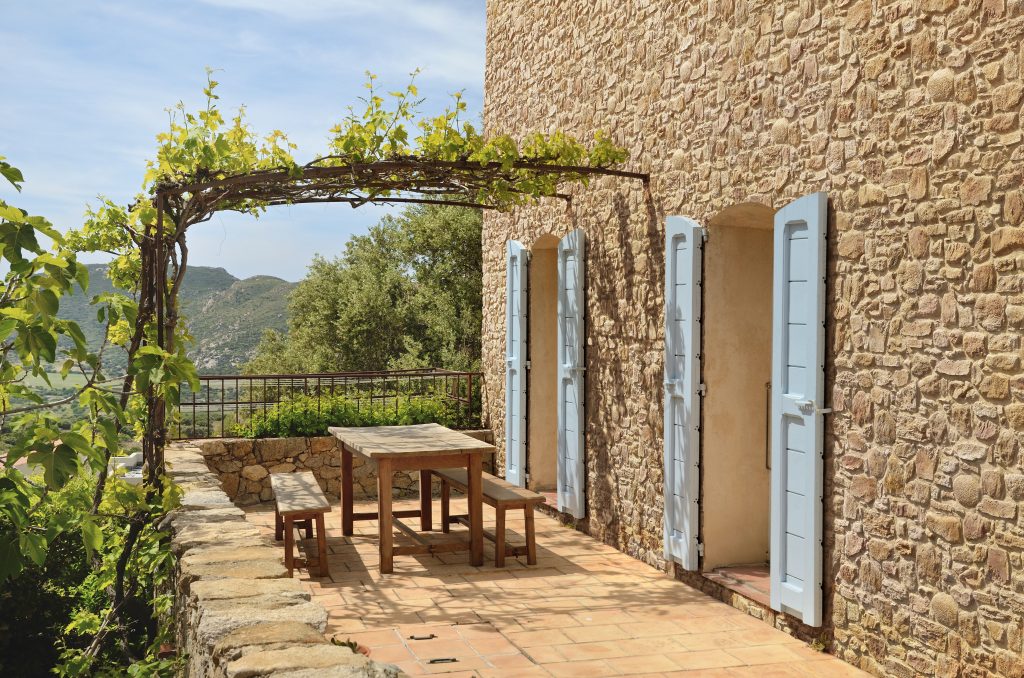
Ambiance photo ORSOL Roca corse rosé, terrace with view, charming building, Mediterranean ambience

Creating outdoor living spaces

Stone terraces provide a pleasant outdoor living space that stands the test of time (wear and tear, frost, UV rays, bad weather…). They blend harmoniously into the garden, extending the interior space outwards.

Choosing the right material

Easy to maintain, stone is a wise choice for terraces. It is weather-resistant and retains its appearance over time. Natural stone slabs and pavers add a touch of authenticity to any setting, and can be adapted to a variety of architectural styles.

The Orsol Neomineral stone cladding collection offers all the nuances and character of natural stone in an innovative, low-carbon cladding designed to last without maintenance.

Launch of the sample store: test ORSOL Neomineral claddings

New 27 May 2025
un livreur tend un colis avec des échantillons ORSOL à l'intérieur

Test our Neomineral stone wall claddings before you decide. The new sample store opens the doors to the entire Matiera universe, which includes Orsol, Noviroc and Brikelia.

How can I order a sample of ORSOL Neomineral cladding?

Fascinated by the aged limestone look of CAUSSE cladding? Are you hesitating between the rustic charm of MANOIR cladding or the dry stone of the ROCA collection? Order your test Orsol products now from the Matiera store.

In the sample store, you’ll find all the leading products in the ORSOL Neomineral stone collections. Choose the product or products you’d like to see in real-life conditions. Up to two samples are reimbursed on presentation of proof of purchase in store or an installation invoice.

Our products are manufactured in the South-West of France and delivered to your door within 3 to 10 days via Colissimo. This means you can take your time to assess the suitability of the cladding in its installation environment, without disrupting your construction schedule.

We deliver to mainland France, Belgium, Switzerland, Spain, Luxembourg, Italy and Germany.

Why test siding before you buy?

After 30 years of expertise, ORSOL is a trusted brand partner for building professionals and homeowners alike. Its collections reflect a wide range of expertise, each with its own unique authenticity. The best way to find the one that’s right for your project is to test it out by ordering from our sample store.

Evaluate actual rendering

The look of your cladding can change significantly from one environment to another, depending on exposure to natural light, color and the character of the surrounding structures and buildings.

Compare several options

Having the two samples side by side allows you to better assess the qualities of each. When the comparison is made under actual installation conditions, you can’t go wrong.

A store designed to simplify your projects

Ordering your samples from the Matiera boutique means enjoying a smooth, secure experience. Online payment is completely secure, and our refund policy is clear: up to two samples refunded on presentation of proof of purchase or installation.

Our sales team, based in France, is on hand to advise you and answer all your questions promptly. Unsure about a color? Hesitating between two collections? We’re here to help you choose the ideal cladding.

For architects and interior designers, samples are an excellent means of communicating with customers. Generally speaking, test products are reassuring. If it’s evaluated on the installation site, it can be convincing very quickly.

Test our facings, compare, plan, and validate your choice with complete peace of mind.

A haven of freshness at Sophie’s

Non classifié(e) 05 May 2025
Pool house baignée de lumière spacieuse avec un mur en pierre

Photo credits: François-Xavier Driant

A natural, Mediterranean-style pool house thanks to ORSOL siding

Sophie has been living on the outskirts of Lyon for the past ten years, and has chosen to swap the hustle and bustle of Paris for the verdant tranquillity of the Rhône-Alpes region. In 2023, she launched a vast landscaping project with a clear objective: to rethink her 2,000 m² garden to make it a harmonious, functional and refreshing place.

A pool house for summer living

With an existing pool and increasingly hot summers, creating an attractive, shaded pool house quickly became a priority.

We needed a space where we could escape the heat, read quietly, entertain friends… and still enjoy this side of the garden.

Sophie is also keen to incorporate sustainable architectural choices, notably with a light-colored roof to reflect heat and maintain natural coolness around the pool.

TERTUS stone cladding for a rough, southern feel

To bring warmth and authenticity to the project, Sophie wanted to marry textures: wood, raw concrete and mineral cladding. After much research, she discovered ORSOL’sTERTUS collection , a wall cladding that perfectly imitates the look of natural dry stone, without the constraints of installation or the high cost.

I was looking for a seamless cladding with a raw, Mediterranean feel. The natural shade of TERTUS harmonized perfectly with the light concrete and wood already present.

Careful installation for a natural look

An experienced tiler carried out the installation, with a few adjustments to preserve the seamless effect while guaranteeing stability.

In the end, a light, almost invisible, recessed grouting was applied to fill in some of the gaps. The final result is superb!

Today, this ORSOL Neomineral stone pool house captivates visitors with its natural, contemporary and welcoming style. The recently installed wooden terrace further enhances the warm, elegant ambience around the pool.

ORSOL’s TERTUS collectionreally was an ideal alternative to natural stone, which was far too expensive. The result has exceeded our expectations.

Read also

The Tertus collection sublimates a pottery school in Corsica

Pierrette and Youval’s school of happiness

Non classifié(e) 14 Mar 2025
Maison en pierres beige clair avec bardage bois, entourée de végétation méditerranéenne, en Corse.

Located in the heart of Solacaro, a small village of 400 inhabitants just a few kilometers as the crow flies from the sea, Mr. and Mrs. Capelle have created Corsica’s first pottery school at the heart of the town’s Centre Culturel et Social des Arts de la Terre.

The facility is designed to harmonize with the rural environment, integrating wood and stone, and offering a warm energy that appeals to visitors. Construction of the center was completed in 2023. Mr. and Mrs. Capelle discovered ORSOL cladding and were immediately seduced by the aesthetics and quality of the products.

“The installer, a local craftsman, was a great pleasure to work with. High-quality products!

The couple wanted cladding that was as close as possible to the look of the traditional “casetta”, a small isolated dwelling in rural Corsica made of assembled dry stone. Together, they naturally turned to the shaded beige Tertus Collection, which was closest to the light ochre telluric background of Corsican earth.

The Tertus collection is completely rural and traditional. With wood, it’s wonderful and timeless.

All visitors think the Center has been there for decades…

The impact of facade materials on buildings’ carbon footprint

Inspiration 17 Feb 2025

Low-carbon facade materials play a decisive role in reducing the environmental impact of buildings. With the NÉOMINÉRAL® innovation, Orsol offers a high-end cladding solution compatible with low-carbon construction projects.

The low-carbon principle

Low-carbon neighborhoods, architecture and equipment: all these projects have in common the reduction of greenhouse gas (GHG) emissions throughout their lifecycle.

How to assess the environmental impact of materials?

A material’s life cycle extends from the moment it is collected or extracted to the moment it is recycled, recovered or reused after the building has been demolished.

In the meantime, the material will have been transformed, using processes that are more or less energy-intensive and/or polluting. It will have been transported, with an inevitably higher carbon footprint for resources geographically distant from the construction site.

The ultimate low-carbon material is one that is produced locally, undergoes little processing and can be easily recycled at the end of its life cycle. The conditions of installation are not insignificant either.

Exemplary projects in this field rely heavily on off-site assembly to reduce constraints and lead times, and consequently the number of carbon-intensive return trips made by professionals.

The weight of materials in a building’s carbon footprint

On a building scale, materials have a major impact. The least eco-responsible materials have production processes that consume fossil fuels and water. This is the case with aluminum and steel, which consume a lot of energy and water for cooling. The use of recycled metals is a good way of minimizing this footprint.

It is also possible to mobilize materials whose initial production process is more virtuous. These include bio-sourced and geo-sourced materials such as wood and natural stone . Favoring these locally available resources is an essential lever for reducing greenhouse gas emissions.

The role of facades in reducing carbon emissions

The carbon weight of the façade has been estimated at between 8% and 25% of the building’s total footprint. A considerable share calculated on the basis of several multi-family housing and office construction projects, as part of a study by the French Institute for Building Performance (Ifpeb) and the Carbone 4 consultancy, published in 2022.

The study reveals several ways in which facades can improve their carbon footprint. The use of less carbon-intensive materials is naturally encouraged, underlining the environmental impact of the type of exterior cladding, but architectural choices also play a role.

Glass walls are both more carbon-intensive and less decarbonizing. In other words, the prospects for optimizing the energy efficiency of a generously glazed building are slimmer. Here,traditional architecture seems to come out on top, with glazing-efficient facades and the use of locally available materials.

RE2020 2025 threshold requirements

The RE2020 environmental regulation provides for new emission thresholds to be phased in by 2031 to encourage low-carbon construction. The aim is to reduce the sector’s GHG emissions by 30%.

The facade and its external joinery are among the batches taken into account in the calculation of the IC construction indicator to assess the impact of products and equipment used on a building site on the environment.

Between 2022 and 2024, the maximum value of the CI for house construction was 640 kilograms of CO2 equivalent per square meter (kg CO2 eq/m²). It falls to 530 kg CO2 eq/m² for the period 2025 – 2027, reaching 415 kg CO2 eq/m² by 2031.

NÉOMINÉRAL®, Orsol’s low-carbon cladding solution

Orsol, a specialist in top-of-the-range cladding made in France, offers creative and innovative solutions that enhance characterful architecture and the unique charm of natural stone. Thanks to the composition and production conditions of its NÉOMINÉRAL® material, Orsol offers an alternative for low-carbon building facades.

Composed of 99% mineral-based materials, its various colors are obtained using natural pigments. The cold production process, based on the pozzolanic reaction, maintains a low level of CO2 emissions. Production waste and water are fully recycled.

Manufacturing in the Nouvelle-Aquitaine region reduces transport-related emissions. Orsol’s suppliers are all European, and 93% are based in France. The installation system, validated by the CSTB, is simple and complies with the performance requirements expected in the construction industry.

NÉOMINÉRAL® responds to the need for low-carbon materials capable of meeting the increasingly stringent environmental impact requirements of the building industry.

How can you add warmth to your wall decor?

Inspiration 14 Jan 2025
causse sur treillis

In winter, more than ever, the home is our comfort zone. This season’s decor should make you want to curl up in the coziest corners of the house. The materials to favor are wood, velvet, wool… In other words, avoid anything that conveys cold or the idea of cold. To take things a step further, you can dress your interior walls with cocooning coverings that meet these criteria. Here are a few ideas.

Decorating ideas for a warm living room

Orsol, a specialist in low-carbon stone, offers top-of-the-range cladding products for every room in the house. For a warm living room, textured red brick is a must, while smooth stone goes easily with contemporary interiors.

Textured red facing brick near the fireplace

The natural hues of brick are perfectly reproduced by Orsol facings. Non-flammable, these products can be installed quickly and easily behind a stove or around a fireplace insert. Nevertheless, a few precautions must be taken to ensure proper installation. The Orsol team is at your disposal to answer any questions you may have. You’ll also find advice and best practices in this article on installing cladding behind a heat source.

Smooth stone finishes for contemporary warmth

It’s not easy to create coziness in a contemporary interior. Generous volumes, large bay windows, the cool aesthetic of metal and raw materials… At first sight, this style is in opposition to rustic architecture and its small cottage or country house-style interiors. To bring warmth to these modern spaces, you need to play with furniture, accessories (curtains, plaids, cushions…), lighting and coverings. In the Orsol collection, smooth-finish facing stones such as Bercy or Infinity are ideal for bridging the gap between modernity and conviviality.

Cosy and comforting bedroom furnishings

In bedrooms, your cozy bedding will ideally be framed by a textured stone accent wall to give the room relief. The idea is to move away from aseptic walls and avoid uniformity of shape and color.

Several Orsol solutions meet this challenge with irregular stones and a variety of colors in warm shades. The Causse and Manoir collections offer reconstituted stone in a variety of sizes and harmonious shades, starting with a “sienna” or slightly darker “rose red” tone.

Collection Causse ton naturel – @noemie_instantcosy

The Meulière collection also offers a variety of colors and stone sizes, but with the deeper reliefs characteristic of meulière stone. The rubble look and shell-like reliefs are ideal for decorating a cosy bedroom in winter.

Original, easy-care kitchen surfaces

The kitchen is a convivial space that must above all remain functional. So, a warm winter decor, yes, but not at the cost of brightness.

Aged limestone is ideal for adding depth while reflecting light. With the Causse collection on trellis, the stones are assembled seamlessly in highly instinctive, irregular patterns. Shades range from “natural” to “golden beige” for clarity. Ideal for a rustic kitchen.

causse on trellis

For more contemporary, but no less cozy interiors, the Cubik collection is a good option. It, too, brings a dose of irregularity, but with rectangular-shaped stones. A fine balance between raw texture and controlled form, reminiscent of the geometric volumes of modern buildings.

Living room with wall cladding in natural-tone Cubik sheet from ORSOL, wall-mounted TV.
Cubik ton naturel – @une_villa_au_soleil

Easy to maintain, Orsol siding can be cleaned to preserve its original appearance, even in rooms prone to soiling.

Traditional architecture and regional facings

Inspiration 20 Dec 2024
maison avec façade en pierre

A return to the architecture of traditional houses has become a necessity in a context where local resources and know-how are valued. These best practices, partly handed down through use, constitute a heritage rooted in the region, and a new source of inspiration for designing naturally resilient buildings.

This is reflected in facade cladding trends, with a pronounced taste for references to locally available materials. Here are some ideas for applying Orsol cladding in regional styles.

Collection Meulière, a nod to Parisian mansions

Millstone was the emblematic material of 19th-century and early 20th-century middle-class homes in the Paris region. It is also found in the richly ornamented villas of the Art Nouveau style. These characterful buildings are also known as meulières or maisons meulières.

Driven by its passion for stone, Orsol seeks to revive this unique character with its reconstituted stone solutions from the Meulière Collection. The result is perfect, with a product that’s reliable, resistant, more flexible and easier to install for Meulière house-inspired cladding.

Photo credit: Thomas Behuret

Collection Causse: dry stone in Quercy

The Quercy Basin, rich in limestone plateaux, also known as the Causses du Quercy, has given rise to a picturesque architecture, recognizable by its typical houses with adjoining turrets, corbelled tiles (génoise) and covered stoops (bolets). Dry limestone and its naturally ochre tones are inseparable from this style and, more broadly, from the architecture of traditional houses in the South-West.

Orsol’s Causse Collection takes up this singular aesthetic with reconstituted stone in elongated shapes with a fine grain and soft relief, available in natural, sienna or golden beige hues.

Angles collection Causse
Photo credit: Ludovic PLAULT

Tertus Collection: the stacked dry stones of Bonifacio

Corsica’s building tradition reflects the richness of its soils: schist on the Cap Corse peninsula, granite further south and limestone in the Bonifacio region. The local heritage includes exposed stone facades with dry stone dressings, sometimes dry-mounted without mortar.

To recreate this stacked look, also found on low walls and exterior walls, Orsol offers reconstituted stone cladding from the Tertus Collection, available in natural, shaded beige and golden beige tones.

Photo credit: Corinne Godard

ROCA Collection: for mountain refuges

At high altitude, local people have made do with the resources of the land, mainly wood and stone. Although these materials are locally abundant, they are not necessarily readily available. Smaller stones may have facilitated transport and played a role in traditional mountain architectural styles. The use of stones in a wide variety of sizes also reflects the need to make the most of all available resources.

The Roca Collection reflects this approach to home architecture, with great variation in both the size of the stones and the shades of each of the reconstituted stones assembled on a ready-to-install lattice.

What about the granite of Breton houses and the shelters that line coastal paths? Orsol is currently working on the launch of a new Granite Collection in 2025 for the reconstituted stone facings of typical Breton houses.

A mountain chalet with "Roca" cladding by ORSOL is nestled in a snowy landscape. The chalet features a harmonious combination of natural wood and gray stone cladding, giving it a rustic yet elegant appearance.